Showing posts with label Revolutionary War. Show all posts

Sunday, June 28, 2009

Artificers and Laborers at Mount Tirzah in Caswell County, North Carolina, 1781-1782

Artificers and Laborers at Mount Tirzah in Caswell County, North Carolina, 1781-1782
by Terri Bradshaw O’Neill* - 2009©
Col. Stephen Moore moved his family from his native New York to North Carolina sometime between May of 1775 and September of 1776. (Family letters: Rebecca Moore to Stephen Moore at West Point, 10 May 1775; Stephen Moore in Philadelphia to Grizey Moore, North Carolina, 18 Sep 1776. Stephen Moore Papers, South Caroliniana Library, University of SC, Columbia, South Carolina.) He was living at his inherited estate at West Point, New York, and the “Rumor of War” was a likely reason for the move. The Moore family initially arrived in Granville County; Stephen soon set about acquiring land in the Deep Creek and Flat River area of Orange County which eventually became Caswell County, and then later, Person County. (Katherine Kendall Kerr, Caswell County, North Carolina, Deed Books 1777-1817, Easley, SC: Southern Historical Press, 1989.) He established his home, naming it Mount Tirzah, and engaged in Planting and trade, setting up a store or trading post. When Caswell County was formed Stephen Moore was appointed one of the Justices, and sometime in 1779 or 1780, he was appointed a Lieutenant Colonel in the Second Regiment of North Carolina Militia under Col. Ambrose Ramsey. (Revolutionary War Pension Application of William Ray, Sr., micropublication M804, Roll 2006, National Archives, Washington, DC) After participating in the disastrous Battle of Camden, SC, on 16 Aug 1780 and becoming a captive of the British, he was marched to Charleston where he was held until his exchange in June of 1781. Upon his return to North Carolina, Col. Stephen Moore was once again an active participant in the war effort as evidenced by the following Return, his home serving as Post Mount Tirzah. He also served as Deputy Quartermaster General of Hillsborough District. From the time of his return from captivity, through the duration of the War, Stephen Moore actively sought compensation for the damages and losses to his West Point property. On the recommendation of Gen. Henry Knox, and at the urging of Gen. George Washington, the fledgling United States government finally bought West Point from Stephen Moore in 1790.

Col. Moore’s return of artificers (which is endorsed “Artificers & Labourers employed at Post Mount Tirzah, 1781-82”) is preserved in Treasurer’s and Comptroller’s Papers, Military Papers, 1781-1782, Box 9, North Carolina State Archives, Raleigh, NC. There are 33 men named in this return. The entire list may be seen in The North Carolina Genealogical Society Journal, Vol. XXV, No. 4, November 1999: 411-17. For the purposes of this blog, only one name is being listed, that of Robert Moore. The significance of the fact that Robert Moore, son of Stephen Moore, served a term in the Militia, is that all of Robert’s descendants would qualify for membership in the Daughters or Sons of the American Revolution on his own service as well as Stephen’s. And, this further reinforces the 1762 birth date for Robert in that he could hardly have served in the militia at the age of 12, but a young man of 19 would certainly be the ideal age to serve as an express rider.

Return of Artificers & Labourers enter’d in the Q’r Masters Department under direction of Col. Stephen Moore Mount Tirzah Caswell county.
1781
persons Name Rob’t MOORE
when enter’d 11 September
occupation Expr’s [rider]
Terms M’a Tour [militia tour]
Time to serve 3 month
Job engaged for
Casual remarks

* Excerpted from The North Carolina Genealogical Society Journal, Vol. XXV, No. 4, November 1999: 411-17.

Thursday, June 25, 2009

History of North Carolina by John Wheeler Moore

by David Jeffreys, June, 2009
Doing a Google search this afternoon, I came across a book entitled History of North Carolina by John Wheeler Moore written in 1880. I recommend it for study of the era before the Revolutionary War, the war itself, and the antebellum period. Detailed accounts of battles such as the Battle of Camden and Guilford Courthouse as well as many others are included. Learn about many prominent individuals, especially General Gates, General Greene, and Lord Cornwallis. Our eminent elder, Stephen Moore, however is not included.

The author claims he was a relative of ours as he explains in a footnote in the book:

the government in their pardon. How have your actions contradicted your words? Out of twelve that were condemned the lives of six only were spared. Do you know Sir that your lenity on this occasion was less than that of the bloody Jeffreys in 1685? He condemned five hundred persons but saved the lives of two hundred and seventy."*
______
* NOTE.-- I adopt the suggestion of one for whose taste and judgment I entertain great respect in assuring the reader that no blood relationship exists between the author of this book and the Cape Fear Moores. My ancestors of that name came from Virginia and were related to Bishop Moore and Colonel Stephen Moore of Mt Tirzah. Judge Moore figured so largely and so much in accordance with what patriotism and propriety dictated, that my commendations have been but what was fairly due him and are in no wise the result of family vindication.

This book is in the public domain and was scanned from an original in the Harvard College Library.

If you would like a copy of this eBook, you may either read it online or download it in Adobe pdf format for your library at this link:

http://books.google.com/books?id=sDQtAAAAYAAJ&dq=Stephen+Moore+Mount+Tirzah&source=gbs_navlinks_s

_______________________________________________________

Wednesday, June 24, 2009

Col. Moore of Caswell County, NC: Stephen or William?

Please see the comment on Stephen Moore Genealogy in which Terri O'Neill calls into question where General Nathaniel Greene camped. This is the article she wrote in the Moore / Stanford / Webb Chronicles in 1994. -- David Jeffreys
______________________________________________________

Col. Moore of Caswell County, NC:
Stephen or William?

In the course of studying Stephen Moore as he moved his family from New York to North Carolina and established himself as a planter, merchant and citizen active in local affairs, there have been several instances of a Col. Moore of Caswell County being mentioned, but it didn’t seem likely that it was Stephen Moore to whom the reference was made. Using many varied sources, it soon became apparent that there were several Moore families living in the area of Orange County that in 1777 became Caswell County, and that there were two men who later were referred to as Colonel Moore of Caswell. Some of the citations to events that were attributed to Stephen Moore are more likely to have occurred in the life of Col. William Moore.

Col. William Moore appears in the records of Caswell County from its formation in 1777. William S. Powell’s When the Past Refused to Die: History of Caswell County 1777-1977 lists six men by the name of Moore/More in the northern part of Orange County who signed a petition to Gov. Tryon in 1771 to form a new county: Arthur, James, John, George, Richard and William, and later records list Abram, Dempsey, Moses and Samuel Moore. The same book states that in 1777 William Moore served on a commission charged with finding and laying out the place where the court house, prison & stocks would be built, was appointed one of the first Justices of the County (as was Stephen Moore), and was chosen Clerk of the Court. In addition, William Moore was appointed as an overseer of certain roads, and was designated a Lt. Col. of the state militia. These offices closely parallel the offices and appointments of Stephen Moore. Examination of the tax lists and deed records helps to distinguish between the two men. William Moore’s land holdings were in the western part of the county, while Stephen Moore’s were in the south east corner of the county which was eventually incorporated into Person County in 1792. According to the Revolutionary War pension applications of several different men, William Moore was already an active Militiaman when Stephen Moore arrived in North Carolina in late 1775 or early 1776. The pension application of James Turner states that he served two tours of duty in 1776 under Col. William Moore, one of 2 months duration from April to June, the other from July to September. This second tour was an expedition against the Indians on the western NC frontier. James Turner’s third tour commenced 29 May 1780 under Col. Stephen Moore, and he then participated in the Battle of Camden.

The Battle of Camden, SC, occurred on 16 Aug 1780, and both Col. Stephen Moore and Col. William Moore were there with their respective North Carolina Militia units. The key fact is that Col. Stephen Moore was captured and sent to Charlestown as a prisoner of war, but Col. William Moore escaped capture and returned home. Col. Stephen Moore was not exchanged until the following June, 1781.

From various other pension applications, it is possible to determine that William Moore participated in many expeditions, skirmishes and battles of the war:
Apr 1776-J Turner’s application
Jul 1776-J Turner, J Ray
1778 or 9-Indian expedition-McBroom
Camden-Aug 1780-J Dollar, B Long, J Clayton
Pyle’s Defeat-Feb 1781-T Miles
Guilford CH-Mar 1781W McMenemy, A McBroome

There are three specific instances in which the records concerning “Col. Moore of Caswell” can be easily confused. Since all three are during or very near the time of Stephen Moore’s captivity, it is very likely that the three events refer to William Moore. According to North Carolina State Records, Vol. 19, p. 383, Stephen Moore served in the May 1780 session of the Assembly which took place in New Bern from April 17th to May 10th. Allowing for travel time, Stephen was surely back in Caswell county by May 20th at which time he was probably engaged in Militia activities. The pension declaration of James Turner states that by the end of May or beginning of June, their march toward Camden had begun. The battle took place on 16 August 1780. Again citing NC State Records, Vol. 14, p. 384, on the 21st of September 1780, the Board of War wrote to Gen. Butler, who had escaped capture at Camden: “Inclosed is a list of the Articles taken by Colonel Moore of Caswell, out of a Waggon belonging to this State, on its way here. [Hillsborough in Orange County] You will direct Colonel Moore to produce the Potts, Kettles, &c for the use of your Brigade; also to account for the Bar Iron. Two Hundred and Seventy Weight appears to be too large a Quantity for any use he could have; it is an Article much wanted by the public, and Colo. Moore ought to produce it.” William Moore had been at the Battle of Camden, too, but he also escaped capture. It was apparently he who took “Articles” out of the “Waggon” since Stephen Moore was on his way to, or already at Charlestown during this period of time.

The second event takes the form of a letter dated 26 February 1781, from Gen. Nathanael Greene written from “Headquarters, Col. Moore’s” in Caswell County to Col. Campbell. At this time, Stephen Moore was a prisoner in Charlestown, SC. The date of the letter is just prior to Greene’s engagement with Lord Cornwallis at Guilford Court House, 15 March 1781. Given the fact that Greene used Troublesome Creek in southern Rockingham County as a base of operations both before and after the Battle, and William Moore’s home was in the western part of Caswell County next to Rockingham County, while Stephen Moore’s home was in the southeast part of Caswell County, it is more likely that Greene was using William Moore’s place as his Headquarters when he wrote the letter.

The third item for consideration is taken from NC State Records, Vol. 15, p. 585: a letter from Maj. Reading Blount to Gen. Jethro Sumner dated 29th July 1781 says that “by Express from Col. Moore, Caswell County we are informed, that it’s thought in Virginia that the Enemy are about to embark for New York, occasioned by the arrival of a French Fleet at that place.” Stephen Moore had just been exchanged in June and according to his itinerary, he reached Tarboro on July 12th, 1781. William Moore’s movements during this time are only partially known. The early part of 1781 is well documented by pension applications. He had been wounded in February at an engagement called “Pyles’ Defeat”, and he had participated in the Battle of Guilford. After Guilford, Gen. Greene turned over pursuit of Cornwallis, who headed towards Wilmington, to the Militia, so it is possible that he was engaged in that activity. While it is uncertain what William Moore was doing while Stephen Moore was making his way back home, it seems unlikely that Stephen could have been reporting enemy troop movements and the sentiments of Virginians although it is possible that he picked up that intelligence on his journey home. William Moore is the more logical choice to have been the bearer of that news.

Eventually, William Moore moved to Smith Co., TN, and was living there in 1823, according to his own pension file. He was born about 1750, making him about 16 years younger than Stephen Moore.

Terri Bradshaw O’Neill, 1994 ©

Monday, June 22, 2009

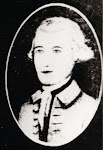
Stephen Moore 1734 - 1799


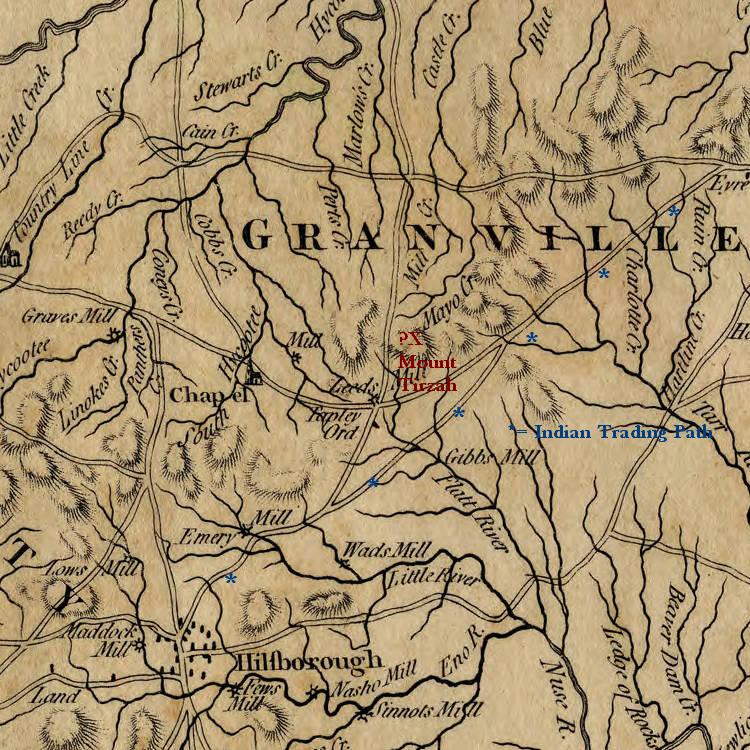
Stephen Moore is certainly one of the favorite sons of Person County, North Carolina. He was awarded original land grants in the area, now known as Mount Tirzah, a name of Stephen Moore’s own choosing. He came to this high promontory and built his home in 1778, just prior to the Revolutionary campaigns in the southern theater of the war and became involved in the war himself, the only member of the large Moore family not to remain loyal to the crown.
Stephen Moore was very patriotic to the cause of the American independence and led a group of North Carolina militia to fight in the Battle of Camden (South Carolina) on August 16, 1780. It was a devastating defeat for Horatio Gates and the militia at the hands of Charles Cornwallis. Stephen Moore and 130 other men were taken prisoner to Charles Town. On May 18, 1781, from the prison ship Torbay in Charles Town Harbour, Stephen Moore wrote a letter to Major General Nathaniel Greene in which he said, “We just beg leave to observe that should it fall to the lot of all, or any of us to be made victims, agreeable to the menances therein contain’d, we have only to regret that our blood cannot be disposed of more to the advancement of the Glorious Cause to which we have adher’d.”
On February 26, 1781, several months earlier, General Nathaniel Greene had camped out at Col. Moore’s home, which was shortly before Greene met Cornwallis at Guilford Court House in the March battle. (see comment #2 below and the post: Col. Moore of Caswell County, NC: Stephen or William?)
In 1783, Stephen Moore petitioned the new government to buy his property at West Point in New York which Gen. George Washington had used during the Revolutionary War as his headquarters. There was already speculation that the government needed this land because of its strategic location on the Hudson River. In a letter in which Stephen Moore was trying to collect money from the now bankrupt U. S. he said, “Had my conduct during the struggles of my Country, proved me an active adversary, I must have silently bewailed the evils, both of banishment & confiscation, and tho I claim no merit for my feeble exertions in the hours of danger, neither can I be persuaded I deserve my present chastisement.”
In October 1783, Moore’s land at West Point was surveyed showing a total of 1617 acres. On a map from the National Archives can be seen the Red House (also known as Moore’s Folly) north of the bend in the river opposite Martler’s Rock. It was the Red House that was used both by the loyalist Moore Family to escape the trials of war in New York City and as headquarters of General Washington about the time of the treason of John Andre and Benedict Arnold. Finally on July 12, 1790, Henry Knox representing the U. S. government and Stephen Moore signed an agreement selling the West Point property to the government.
Stephen Moore had inherited the West Point property from his father, Col. John Moore. Known as Moore’s Folly, it had probably been named Moore’s Fawley, after the ancestral estate of South Fawley Manor in Berkshire County, England built in 1600 by Sir Francis Moore. [Note: There is now some doubt that Honorable John Moore was descended from Francis Moore at Fawley, but more likely from a Moore family in London. See footnote.] Stephen was the 17th child of the union of Col. John Moore (August 11, 1686 – October 29, 1749 and Frances Lambert (who died on March 21, 1782 in her ninetieth year) who were married in 1714.
Stephen Moore was born in New York City on October 30, 1734. In 1754 he was apprenticed to the Hon. John Watts, contractor for army supplies and a N.Y. merchant and member of his Majesty’s Council. Also in 1754, Stephen was commissioned in the N.Y. Regiment under Col. Oliver DeLancey. He volunteered for the French and Indian War in 1756, and the following year received a lieutenant’s commission in DeLancey’s Provincial Regiment. Then he was appointed provision contractor for the British Army. After the war he was rewarded the post of Deputy Paymaster General of Canada.
Stephen continued to live in Canada where he was a sea merchant (like his father before him) in Quebec. He was a member of “Burgess and Guild,” a sea merchant’s fraternal order in Glasgow, Scotland. As a sea merchant, he operated the Bonnie Lass and Bonnie Dundee which were routed between Glasgow, Scotland and Quebec with stops in Jamaica and Barbados. He entered the lumber trade with partner Hugh Finlay (the Postmaster of Quebec).
On Christmas Day, 1768, Stephen married Grizey Phillips (Feb. 18, 1748 – Jan. 15, 1822) and on Nov. 12, 1769, son John was born in Quebec. The infant John died the following year on Sept. 7, 1770. Stephen went bankrupt and left Canada in 1770 returning to N. Y.  Robert was born Nov. 5, 1762, before Stephen's marriage to Grizey and therefore, is the stepson of Grizey. (More information about Robert's birth is in another article on this blog.)
From 1765 to 1775, Stephen Moore’s official residence was listed on town reports of Cornwall, N. Y. (near West Point). Their son Phillips (born July 12, 1771) and daughter Frances (Dickens) (born Nov. 5, 1773) were born in New York. In 1775, Stephen moved his family to Tally-Ho in Granville County, N.C. where daughter Ann was born (Jan. 12, 1777). A fire in lower Manhattan, a consequence of the war, burned Trinity Church and the Moore home to the ground.

Stephen obtained in Mount Tirzah land in Jan. 1777 and built his home in 1778 (the date exists on a stone in the basement stairs), a beautiful structure on the Mount Tirzah hilltop. The home is believed to be the second oldest in Person County, with the original part of the Lea home being older. Stephen continued acquiring land until he had a plantation of approximately 3000 acres. His brother, Charles and his brother-in-law, Thomas Phillips, also moved to Mount Tirzah. Stephen petitioned the federal government for a post office at Mount Tirzah and was successful in having his brother, Charles, named postmaster.
Approximately a quarter mile to the south of his home, Stephen returned to merchandizing by building a store, which became an important place of trade, as he was the only merchant within a ten to twelve mile radius, prior to 1800. This country store was probably the local gathering spot for the latest news of the region and more distant places. In addition to buying and selling with the local farmers, Stephen dealt with more distant merchants such as Richard Bennehan at Stagville, N.C., and with merchants of the major trading and distribution point of the times in Petersburg, Virginia.
There was a road from Mount Tirzah to Raleigh which passed through the plantation of Richard Bennehan (later the immense and famous Cameron Plantation). At Stagville, Richard Bennehan’s home, this road bisected the old Indian Trading Path, which was the major north-south route of commerce of the times. The Indian Trading Path extended from Petersburg, Virginia, in the north to Salisbury, North Carolina, on the Yadkin River in the southwest.  (I-85 roughly follows the Indian Trading Path.)
Evidence from the Stephen Moore papers suggests that his brother-in-law, Thomas Phillips, and his son, Phillips Moore, participated in the day to day running of the store and keeping the day books and ledgers. Most of the ledger books were in the hands of Phillips Moore, and there is one entry that suggests that his uncle, Thomas, was not an able bookkeeper, which states as follows: “There are so many wrong entrys in the Ledger made by my Uncle Thos. Phillips, that the day book must be again posted or the accts. cannot be properly adjusted. 13th Jan. 1816. Phillips Moore (signed).”
The Mount Tirzah store made many daily transactions with the local farmers and with the merchants in Petersburg, and there are entries in the day books which keep a running account of amounts drawn and credited. In Petersburg on 8 February, 1797, Phillips Moore “Bought of Eleazer F. Backus” various sundry items such as pepper, allspice, needles, nutmegs, a fine comb, cloth, hammer, nails, awls, a lock, paper, calico material, scissors, coffee, chocolates, salt, sugar, a hat, a trunk, a wagon screw, and other items for which he paid £17.8.8.
Another transaction with Mr. Backus produced cotton, tea, sugar, paper, scissors, cloth, a blanket, 20 bushes of salt and linen for which he traded corn and pork. This last transaction took place on 23 December 1796, which makes one wonder if he made it home in time for Christmas as Petersburg was more than a hundred miles away on the old Indian Trading Path.
The Mount Tirzah store also rented for hire the employment of the Moore family slaves to the neighboring farmers to help with various farm work. There was considerable business done in potatoes, wheat, and corn. However, the Mount Tirzah store also dealt with a refined product of the grains, that of liquor as many references to brandy and rum would indicate.
Among his other business ventures was a mill which was formerly named Gibbon’s and pre-dates 1769. He also owned a brick kiln. So we see Stephen Moore as a diversified owner of several business interests of which he probably left the day-to-day management to various members of his family. This left him time for an active interest in the Revolutionary War and Politics.
Stephen’ son Marcus was born on Nov. 27, 1780 while he was being held prisoner in Charles Town. Stephen was finally released on June 22, 1781. He was appointed Commissioner for Specific Taxes in 1781 and superintendent Commissioner of Hillsborough District in 1782. On October 15, 1782 another son, Portius, was born.
From 1783 to 1792, Stephen was Deputy Quartermaster General of Army (under Col. Robert Burton, Quartermaster General of N.C.) which is where the title of “General” Stephen Moore comes from. Actually his highest rank was Lt. Col. In 1786 and 1787, he was nominated as representative to Congress, but was not elected.
Two more sons were born: Cadmus on June 30, 1787 and Samuel on June 15, 1789.
Even though Stephen successfully petitioned the bankrupt U.S. government to buy his West Point property in 1790, there is question as to whether he ever collected the 11,085 dollars.
On December 15, 1794, Sidney was born.
At the end of the century, on December 29, 1799, he died at Stagville at the home of Richard Bennehan. It is interesting to speculate why he was there when he died. Had he gone there during the festive season between Christmas and New Year’s and fallen suddenly ill? Was he there on business? Or perhaps Stephen was already ill and had gone to Stagville in search of a doctor since Stagville was a larger plantation than his own and may have had a doctor in residence.
Stephen Moore left quite an impact on Person County, through his activities politically, in the war, economically, and with the many descendants, some of which still live and own land in Person County.
Sources: This article was written by the great-great-great-great-grandson of Stephen Moore for the Person County History, vol. II. Sources include Duke University Archives; Southern Historical Collection, U.N.C.; N.C. State Archives; West Point Library; Miami Public Library (Genealogy Room); Person County Records; Mount Tirzah home and graveyard; and a bibliography of books and articles too numerous to mention.-- David E. Jeffreys, Jr. - written for the Person County Heritage, vol. II, 1983. © Updated May 2010.


_____________________________________________
Footnote: See "A Corrected Lineage of Hon. Moore of South Carolina and Pennsylvania" by Terri Bradshaw O'Neill (Pennsylvania Genealogical Magazine, Vol. 44 (2005) pp. 101-121).