

 Posts
Posts


Doing research always leads to questions as well as answers. Below you will find questions that we would like the answers to. If you have an answer or a source, please leave it in the comments section below or email the answer to me (see Email your editor in the left sidebar). I will be pleased to enter additional questions you may have to this list, if you email me.
1-What is the origin of the Stephen Moore in uniform miniature?
2-Who was Julia, the actress, who may have been the mother of Robert?
3-Information on Dr. Portius Moore, the physician. Details about his education and practice. Supposedly, the chimney of his office has survived.
4-What was family life like among the children and grandchildren of Stephen Moore, Charles Moore, and Thomas Phillips from 1800 on, and did they live in a community still working together around Mt. Tirzah? We have some clues from the ledgers of the store. Was there also a community around Moore’s Mill, which had previously been Gibbons’s Mill, as folks tended to gather around a mill for news, help, and shared experiences? A lot of the answers to these questions may still be found in the Southern Historical Collection at the Wilson Library on the UNC Chapel Hill campus.
5-Who were the families around Mt. Tirzah that interacted with the Moores? For example, the Reades and the Dickins. There was an Osborne Jeffreys, and a Paul Jeffreys that frequently traded at the Mt. Tirzah store recorded in the ledgers; who were they?
6-How many slaves lived on the Mt. Tirzah plantation after 1800? What jobs did they perform? Where did they live? Who were they, by name, and were any given their freedom early?
7-Does anyone have a copy of the presentation that Dr. Bailey Webb gave on Ann Moore, who was the invalid sister of Stephen, that she gave at the 1991 Moore Reunion at West Point?
8-Is there a member of the Webb family that was sufficiently close to Dr. Bailey Webb that they could give us a biographical sketch? I remember her practicing in Durham when I was a child. Did one of you inherit her effects or papers? If not, do you know what happened to them?
ANSWER: I have found the papers in the Special Collections at Duke Univerisity Perkins Library. The papers have not been cataloged and are not available on microfilm. At the present time the collection is closed, pending cataloging. The collection is huge consisting of 5416 items (9.7 lin. ft.). David Jeffreys, 7-28-2009.
Author Webb, Bailey Daniel. Title Bailey Daniel Webb papers, 1845-2001 (bulk 1950s-2001) Location/Request Special Collections Library: Manuscripts 6th 24:B Location/Request Special Collections Library: Library Service Center, Manuscripts (Reading Room only) Library Service Center LSC
9-When was Moore’s mill operated by the Moores? Was it after Stephen’s death in 1799 and during the antebellum period? The Stephen Moore plantation did NOT extend far south enough to be on the Flat River, where the mill was located. Research project: Search deeds where mill was located between 1780 and 1850 to determine owners of the mill site at the Person County Courthouse Register of Deeds office.
10-Stephen Moore has hundreds and maybe thousands of descendants by now; there were several hundred in attendance at the West Point Reunion in 1991. The descendants live all over the country and perhaps the world, and certainly there are a number still in Person County. However, I am not aware of any descendants that live today on the original Stephen Moore Plantation property as it was in 1799. Perhaps some of the Reade family members still live on the northwestern part of the property, but I’m not sure. The Reade family occupied the Mt. Tirzah house into the 1970s and maybe the 1980s, before it was sold to Stephen Cox, the present owner, who has renovated it. QUESTION: Does any blood descendant live on the original plantation TODAY?
11-Was Stephen Moore, his estate, or members of his family ever paid for the West Point Property by the United States government and/or the North Carolina government?
12-Regarding Stephen Moore, I had written in 1983 "At the end of the century, on December 29, 1799, he died at Stagville at the home of Richard Bennehan. It is interesting to speculate why he was there when he died. Had he gone there during the festive season between Christmas and New Year’s and fallen suddenly ill? Was he there on business? Or perhaps Stephen was already ill and had gone to Stagville in search of a doctor since Stagville was a larger plantation than his own and may have had a doctor in residence." This may be true or it may be family folklore, but I've always thought it rang true. So far, I don't know of any documentation in the Bennehan-Cameron Papers around 1799, that are located in the "Southern Historical Collection" and the "North Carolina State Archives" or anywhere else for that matter, as proof.
13-Would you and/or other members of your family be interested in learning more about our Moore ancestry using DNA testing? If so, let me know, and perhaps we could get together for a lower cost group rate. For example, it might solve the question: did Robert have a different mother from all the other children of Stephen Moore? You might remember the recent interest inquiry and interest by the descendants of Thomas Jefferson. For more information, see: http://dna.ancestry.com/learnMore.aspx. There are other services for DNA heritage testing as well.
Active Moore research continues among several of our family members leading to new discoveries and knowledge. Won’t you join them?
David E. Jeffreys
Showing posts with label Moore's Mill. Show all posts
Showing posts with label Moore's Mill. Show all posts
Monday, July 6, 2009


Tuesday, June 23, 2009
Moore's Mill
by David Jeffreys - June, 2009 ©
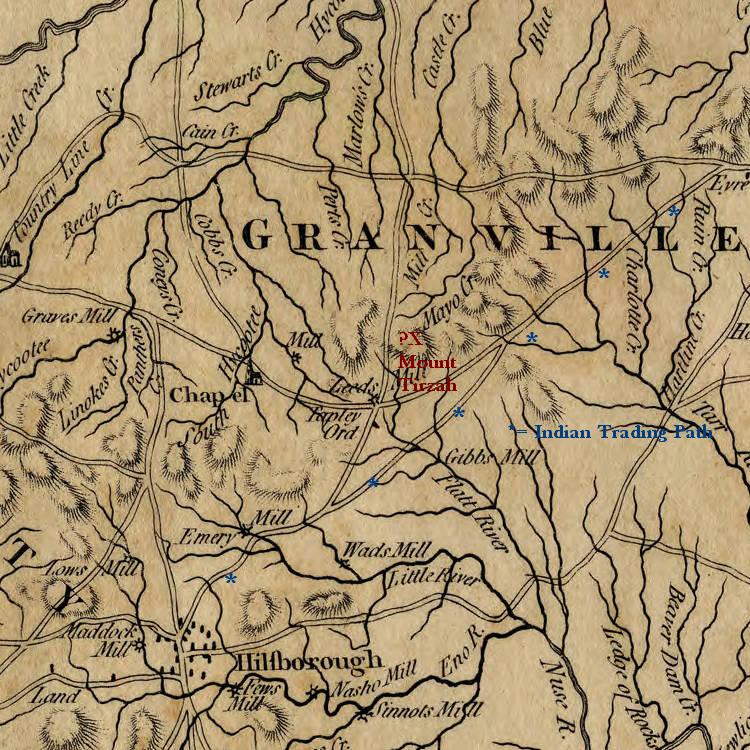
Stephen Moore had a mill on the Flat River that had previously been named Gibbon's Mill. Mills were a common location for the surrounding community to come together for not only milling their corn and wheat, but to swap stories, get the news, and even advertise for their needs.
Traveling north on US 501 from Durham, you will cross the Eno River, where the West Point Mill is located. It is now a park -- West Point On the Eno, and after rebuilding the fallen mill on the old site, the mill is operational once again. More on this later. For more information on this mill visit: http://www.enoriver.org/eno/parks/WestPoint/westpoint.html and http://endangereddurham.blogspot.com/2009/02/mccown-mangum-house-west-point-mill.html
Travel further north, and you will cross the Little River Reservoir. The Eno, the Little, and the Flat Rivers combine to form the Neuse just to the east on the former plantation of the Bennehans (Stagville) and Camerons (Fairntosh). Stagville is now a NC State Historical Site, which you can visit.
Travel further north still until you come to Quail Roost on your left, turn right onto Moore's Mill Road. This road also runs north-south and parallels US 501. You will cross Red Mountain Road and continue north and pass into Person County where the road begins to parallel the Flat River and is subject to flooding when the Flat rises out of its banks. Then you will cross the river on a bridge, and the original Moore's Mill site is just to your left, but there are currently no remains. In 1976, the Durham Morning Herald did a wonderful article on the mills of Flat River with photos by Harold Moore. Here are copies of those photos.


Millard Thacker, a neighbor on the other side of the bridge, told me: "The old wheel was donated by a previous owner (Mark O'Neal) to the ENO RIVER/PARK HISTORICAL GROUP AND IS IN OPERATION AT THE ENO RIVER SITE ON HWY 501, JUST NORTH OF DURHAM." So that puts us back to the West Point on the Eno Park.
After crossing the bridge, you will begin climbing higher and higher, passing the mountain on which the fire tower is located, and then climbing higher still until you reach the Helena - Moriah Road. This junction is where it is believed that the original Moore Store and Mt. Tirzah post office were located. Turn right and then in a few yards turn left onto the Mt. Tirzah - Surl Road, and you will see the Mt. Tirzah United Methodist Church on your right. Continue climbing to the top of Mt. Tirzah. The Stephen Moore home built in 1778 will be on your right at the top, which now puts the large plantation in context. A mile or so to the east on the Helena - Moriah Road, you will cross Deep Creek, which ran through the eastern part of the Stephen Moore plantation. Deep Creek empties into the Flat River below the mill and near the Person County - Durham County line.
Subscribe to:
Posts (Atom)