Showing posts with label Robert Moore. Show all posts

Sunday, May 27, 2012

D A R and S A R

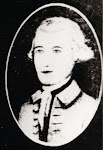
Being descended from Stephen Moore, our Revolutionary War Patriot, entitles you to membership in either the DAR (Daughters of the American Revolution) or the SAR (Sons of the American Revolution.)

Starting from scratch and going back six to eight generations may be daunting to some; however, if a more recent ancestor has been accepted into membership, you will have fewer generations to prove.  For example, my mother was a member of DAR, so it was relatively easy for me to prove my lineage back to Stephen Moore, only having to supply my birth certificate, proving the last generation.  Even finding a relative back in your lineage in one of the DAR or SAR rolls will save you time and documentation.

Terri O'Neill has shown that Robert Moore also had creditable service as a Revolutionary War Patriot, but if you get back that far, you may as well go for one more generation to Stephen.

Not all Moore family descendants can become members of the DAR and SAR -- only those who are descended from Stephen.  This is because only Stephen was a Revolutionary War Patriot having fought in the war for independence.  Most of Stephen's siblings remained loyal to the British Crown!

Here is copy of my Sons of the American Revolution Certificate:  I have been a member since 14 June 1979.


If you will add your DAR or SAR national certificate number in the comments below, I will add it into the following table.  This should make it easier in the future for our descendants to apply for membership.

DAR or SAR:  National Number:      Name:                                    Date:              .

SAR                 115865                      David Elmo Jeffreys, Jr.         14 June 1979
DAR                728184                     Terri Bradshaw O'Neill            2 February 1990
SAR                                                    Mike Andrus                               2012
DAR                911467                      Sarah Brodeur Johnson          October 2012
DAR             926546                     Sandra Moore Shoffner          11 December 2013

Thursday, July 9, 2009

The Ante-Bellum Mount Tirzah Plantation

By David E. Jeffreys, written in July, 2009 ©
The ante-bellum period is defined as being that time between the Revolutionary War and the War Between The States or from 1800-1860. What was life like during this period at Mt. Tirzah? Though Stephen had died at the very end of the previous century (29 December 1799), his widow, Grizey, lived well into the new century, along with her brother, Thomas, and her sister-in-law, Ann. Most of the children still lived at the plantation, although some of the grandchildren would start to move away and even out of North Carolina, beginning the spread of the descendants.

Charles was listed as the postmaster of the Mt. Tirzah post office. Phillips, along with his uncle Thomas Phillips, would manage the store.

[Southern Historical Collection]
Phillips son, Stephen, would move to Hillsborough where he owned a shoe store. Many letters between Phillips and his son are collected in the Southern Historical Collection in Chapel Hill.

Also preserved are many letters between Ann Moore, Grizey Moore and Throg’s Neck, N.Y., where much of the rest of the Moore family resided, as they remained in touch with the greater family at large. An example:

[Southern Historical Collection]

A wonderful book about this period, Ante-Bellum North Carolina – A Social History, by Guion Griffis Johnson was published by the University of North Carolina Press in 1937. Vicky Wells of the UNC press has kindly given me permission to quote sections of the book, which has long been out of print. Contained in this book are many excellent references about the Mt. Tirzah plantation life, as Johnson used Moore collections in the Southern Historical Collection extensively:

THE OVERSEER
Upon the skilful management of the slaves often depended much of the success of a plantation. Surly hands could defy an overseer, break a vast amount of equipment, and otherwise interrupt the plantation routine without seeming to do so.
Most of the large plantation owners employed overseers to assist in the management of the Negroes and the crops. . . .
An excellent overseer, or superintendent, as he was sometimes called, was difficult to find. The work was strenuous, the pay small, and the requisite personal qualities usually above those of the person willing to engage in such a profession. It was customary to furnish an overseer lodging and to pay him in one of three ways: a money wage payable in notes which might be converted into cash at a discount, a smaller money wage supplemented with a specific amount of provisions, or a share in the crop and certain specified provisions. The customary money wage in the last half of the ante-bellum period varied from $125 to $250.
The relation between Phillips Moore of Mount Tirzah in Person County and his overseer, Nathaniel Smith, during the planting year of 1819-1820 was typical of conditions on many a small plantation. In November, 1819, owner and overseer entered into the following agreement:

Said Smith undertakes to perform the duties of Overseer for said Moore under his particular advise & direction, to take charge of the hands, the work with them diligently, to assist in feeding the stock of every kind, with all care of the same that is requisite in all seasons of the year, to see that there is plenty of fire wood always provided at the door for the house fires, to take care of all the farming utensils of every description, and have them housed except when immediately in use, to repair fences, take care to prevent any damage or loss of any kind whatever, and to make up all loss time whatever, & find himself.

And said Moore for this part to pay unto said Smith two hundred Dollars or its value for the term of one Year.

To this agreement Smith added a proviso of his own, to which the owner agreed:

And we further agree that if any dispute does arrise which cannot be mutually settled we bind ourselves to leave it to three persons to be chosen by ourselves. . . .

Accustomed to keeping strict accounts at his country store, Moore also kept strict account of his overseer’s activities, charging him at the end of the year with having lost twenty-two and a third days from work. He set down each offense as it occurred so that at the end of the year he had an imposing list with which to confront the overseer: “Nathaniel Smith lost this day, his wife being sick. This day away about your pork. . . . Went away at a time I wanted you to work at tobacco . . . fatening hogs got out, you unconcerned, came & set down by fire. No care taken of tobacco stript the other night, at night a horse verry sick, paid no attention to him. Went to the Court house. . . . Went to muster. . . . Went to Mother in Law’s. . . . . Went fishing, left the plow & horse, & neglected the hands (corn verry foul .ch.d you $1). . . . . Thursday went to the Election . . . went to sale . . . went to General Muster. . . .” Taking out $14 for lost time, about $12 for provisions advanced, chiefly brandy, shoe repairing, and a barrel of flour, Moore discharged his part of the agreement by giving the overseer three notes for $58 each, and set about looking for another manager.
But the new overseer was little better. He was sick much of the time; he went to town on court days and attended elections; often he neglected to go to the remote fields when the people were at work there; and he finally moved away ten days before the expiration of his contract, leaving “my fences down in several places”
[Phillips Moore Papers, November 13, 1819 – December 20, 1821]
[Above taken from Ante-Bellum North Carolina, pp. 489-492]

In the same vein, Richard Stanford wrote on 15 February 1815 from Washington, DC to his wife, Mary, at Mt. Tirzah:
“Can you make some arrangement with your mother for the succeeding crop-I want to do something in that way, but I want an even, & equal one. I pay a large rent, you know, for the place.
Suppose I send down 2 or 3 hands & repair the fences, trim the orchard, etc. & then have a hand with Scipio to go on with the crop, what will be right in the division? If I had an overseer I would rather, but if a suitable overseer cannot be had, I would rather have none.”
[Richard Stanford Papers, North Carolina State Archives]


[Southern Historical Collection]

LIVING CONDITIONS OF THE SLAVES
“Negro cloth” was either plain, homespun, cotton for summer and wool for winter, dyed blue or brown and made on the plantation, or blue checked, osnaburgs bought from a local merchant or in Petersburg, Norfolk, or some northern city. . . .
On some plantations, the spinning, weaving, and sewing were done by slave women unable to do field work, but on others the master employed white women to do the work and the mistress herself sometimes helped. Phillips Moore of Person County regularly employed a white woman to spin, weave, and sew for his Negroes and a man to make their shoes. In 1803, for instance, he paid a Mrs. Hogue £3 for making Scipio “overalls and Jacoat.”
[Phillips Moore Papers: Memorandum Book, December 2, 1803]
Most Negroes were not content with the simple clothes their masters provided, and sought, whenever possible, to obtain a “Sunday best” with their own money. . . .
The Negro cabins, grouped together in a single or double row back of the master’s house, were made of clapboards or of poles chinked with clay. Each had a large fireplace and stone hearth where the family cooking was done, a table, some shelves, and perhaps a rude bed, a chest, and a few plantation-made chairs. It was a common practice for Negroes to sleep in a heap of rags or on a corn shuck mattress on the floor, or on a plank or chair.
[R.W. Gibbs, “Southern Slave Life,” North Carolina Standard, June 30, 1858.]

SLAVE HEALTH
On most plantations the young and the sick received special attention. Enceinte women usually worked at half task until the last few months of pregnancy when only a fourth task was required of them. Phillips Moore, of Person County, employed a Mrs. Bumpass in Chatham County to attend his slave Annica. He paid the midwife her expenses and 10 shillings. As a rule, no work was required of the mother until the infant was a month old. From that time until the child was two or three months old the mother returned to the quarters to suckle the infant. Later the nurse, usually a child, carried the baby into the field to the mother.
[Waste Book, January, 1796-December, 1803, in Phillips Moore Papers.]

THE SLAVE AND HIS MONEY
Since the slave had money in his pocket, he was a potential buyer, and slave money was as good as master’s money. Indeed, unless the planter kept his own store and required his slaves to buy of him, as did Ebenezer Pettigrew of Phelps Lake, the slave was more likely to patronize the small tradesman than was the planter, who frequently bought his supplies in large quantities at a distant market. The accounts of merchants frequently show, as did those of Phillips Moore of Person County, that the neighborhood slaves were in the habit of buying small articles. The Moore Account Book, 1810-1816, records, for instance, that “on the 26th. of Sept. Old Jim had little better than ½ pint of [of liquor] for white onions” and that on April 17 Scipio had “Shoe Leather, supposed to be abt. a balance for Tobacco bot. of him.”
[Moore Account Book, 1810-1816, in Phillips Moore Papers.]

SLAVE FAMILY LIFE
As important as money in the pocket in building up a wholesome morale among slaves was the master’s observance of family life among his black people. He gave each family a place to live; he issued rations by families; he encouraged slave marriages and respected the grief of a family when a member died. Some families built up a strong feel of solidarity and loyalty. . . .
In 1823 L. V. Hargis of Point Pleasant in Person County wrote the following note to Phillips Moore, giving permission for Ben to marry:
D.r Sir Your note by Ben the 25th Instant is before me stating – Ben had communicated to you his desire to take a wife among your negro women. If it meets my approbation. As it appears the boy wants a wife I make no objections & if he undertakes I hope he will not disgrace his Station.
[Phillips Moore Papers: L.V. Hargis to Phillips Moore, August 27, 1823.]

When slaves decided to marry, they went to their master, or to the overseer in the absence of the master, and signified their intention. The master might immediately ask the couple to join hands while he pronounced them man and wife or he might set a day for the ceremony. The wedding might take place in the quarters, the yard, or in the master’s kitchen, and the master might himself perform the ceremony or yield his place to a minister or to a religious leader from among the slaves. After a simple celebration with sweetened water and a meat stew, singing and dancing, the couple went to their new home, a cabin which the master assigned them.
Separation was equally casual. The marriage might be dissolved at the pleasure of either party or by the sale of one or both, being dependent, therefore, upon caprice or the necessity of their owners. The master, however, found it to his advantage to encourage marriage stability and to insist that his slaves abandon their African tradition of polygamy in favor of monogamy. After a certain slave named Samuel of a near-by plantation had lived with Mina, the slave of A. M. Lea of Caswell County, and had had five children by her, he quarreled with her, and bundling up his clothes, he started away, saying that he intended to part with her. Lea, however, compelled Samuel to leave the clothes until he obtained a written permit from his master sanctioning the separation.
[Above taken from Ante-Bellum North Carolina, pp. 524-525, 527, 532-536]

Much more information on slave life on the neighboring Stagville Plantation to the south on the Flat, Little and Eno Rivers is available at http://www.stagville.org/. Examples of two-story, four-room slave dwellings in Horton Grove can be toured as well as the Bennehan home. By 1860, the Bennehan-Cameron family owned almost 30,000 acres and nearly 900 slaves.

During the ante-bellum period, a free Negro named Thomas Day lived in nearby Milton, which is near the Person County – Caswell County – Virginia line. He was renowned far and wide as the best furniture and cabinet maker. For more information on Thomas Day, see the website:

http://www.rootsweb.ancestry.com/~ncccha/biographies/thomasday.html.


SANITATION AND HEALTH: NATIVE SIMPLES
The average ante-bellum family called a doctor only in an emergency or when every other curative means had failed. In 1832, for instance, when a certain child became ill Monday “with a puking and a severe pain in her head, I had her bled and sweated,” wrote her mother. But she still complained of a severe pain in her head and her mother put a blister on the back of the child’s neck. When the blister did not draw well and the child fell into a coma, her parents became alarmed and called a doctor Saturday afternoon, five days after her first attack.
Many a head of a family knew as well how to bleed or draw a blister as did a physician, and his wife, as has already been pointed out, was usually well informed in the knowledge of household remedies. Almost any account book of the ante-bellum period shows that the owner kept on hand a supply of the usual medicines. The Phillips Moore Account Book kept between 1805 and 1811 shows that the following medicines were purchased in Petersburg at various times: two bottles of essence of mustard, a asafetida, senna, opium, two ounces of sal ammonia, blistering plasters and salve, two bottles of sweet oil, and two pounds of copperas. Here was a variety of medicines sufficient to cure almost any ante-bellum complaint.
A great many families, however, could not send abroad for medicines; neither did they obtain them from the supply which every doctor always kept on hand. They relied, instead, upon herbs which grew in the fields and woods. Every granny and a great many housewives, as well, knew the various plants and their properties; knew how to gather and dry them, brew them into decoctions or pulverize them to be taken as powders. These were the “native simples,” so called because of the belief that every country produced a simple remedy for its diseases. A knowledge of their use still exists in a great many families today, especially among the Negroes and the rural whites. Almost any adult can recall having seen his grandmother gathering sage to be used in a tea to cure winter colds or catnip to brew for the baby’s colic.
[Above taken from Ante-Bellum North Carolina, pp. 752-753.]

Of course, we know that Stephen’s son, Portius Moore, was a physician. More research needs to be done to find out if he, too, used the medicines that were stocked in the Moore store and if he used the “native simples.” We do know that the Moores consulted with the famous Dr. Benjamin Rush in Philadelphia on several occasions, particularly regarding the paralysis of Ann Moore.

Sunday, June 28, 2009

Artificers and Laborers at Mount Tirzah in Caswell County, North Carolina, 1781-1782

Artificers and Laborers at Mount Tirzah in Caswell County, North Carolina, 1781-1782
by Terri Bradshaw O’Neill* - 2009©
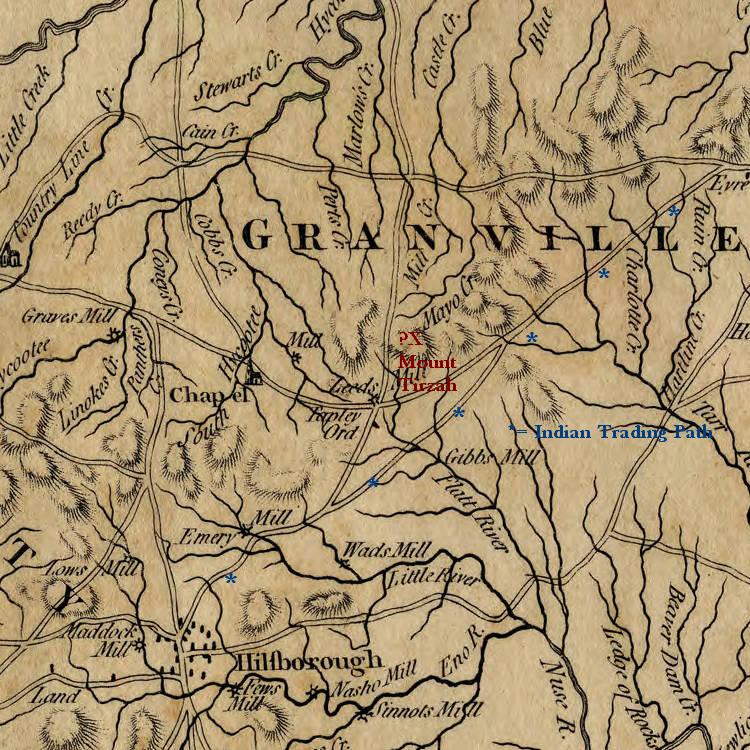
Col. Stephen Moore moved his family from his native New York to North Carolina sometime between May of 1775 and September of 1776. (Family letters: Rebecca Moore to Stephen Moore at West Point, 10 May 1775; Stephen Moore in Philadelphia to Grizey Moore, North Carolina, 18 Sep 1776. Stephen Moore Papers, South Caroliniana Library, University of SC, Columbia, South Carolina.) He was living at his inherited estate at West Point, New York, and the “Rumor of War” was a likely reason for the move. The Moore family initially arrived in Granville County; Stephen soon set about acquiring land in the Deep Creek and Flat River area of Orange County which eventually became Caswell County, and then later, Person County. (Katherine Kendall Kerr, Caswell County, North Carolina, Deed Books 1777-1817, Easley, SC: Southern Historical Press, 1989.) He established his home, naming it Mount Tirzah, and engaged in Planting and trade, setting up a store or trading post. When Caswell County was formed Stephen Moore was appointed one of the Justices, and sometime in 1779 or 1780, he was appointed a Lieutenant Colonel in the Second Regiment of North Carolina Militia under Col. Ambrose Ramsey. (Revolutionary War Pension Application of William Ray, Sr., micropublication M804, Roll 2006, National Archives, Washington, DC) After participating in the disastrous Battle of Camden, SC, on 16 Aug 1780 and becoming a captive of the British, he was marched to Charleston where he was held until his exchange in June of 1781. Upon his return to North Carolina, Col. Stephen Moore was once again an active participant in the war effort as evidenced by the following Return, his home serving as Post Mount Tirzah. He also served as Deputy Quartermaster General of Hillsborough District. From the time of his return from captivity, through the duration of the War, Stephen Moore actively sought compensation for the damages and losses to his West Point property. On the recommendation of Gen. Henry Knox, and at the urging of Gen. George Washington, the fledgling United States government finally bought West Point from Stephen Moore in 1790.

Col. Moore’s return of artificers (which is endorsed “Artificers & Labourers employed at Post Mount Tirzah, 1781-82”) is preserved in Treasurer’s and Comptroller’s Papers, Military Papers, 1781-1782, Box 9, North Carolina State Archives, Raleigh, NC. There are 33 men named in this return. The entire list may be seen in The North Carolina Genealogical Society Journal, Vol. XXV, No. 4, November 1999: 411-17. For the purposes of this blog, only one name is being listed, that of Robert Moore. The significance of the fact that Robert Moore, son of Stephen Moore, served a term in the Militia, is that all of Robert’s descendants would qualify for membership in the Daughters or Sons of the American Revolution on his own service as well as Stephen’s. And, this further reinforces the 1762 birth date for Robert in that he could hardly have served in the militia at the age of 12, but a young man of 19 would certainly be the ideal age to serve as an express rider.

Return of Artificers & Labourers enter’d in the Q’r Masters Department under direction of Col. Stephen Moore Mount Tirzah Caswell county.
1781
persons Name Rob’t MOORE
when enter’d 11 September
occupation Expr’s [rider]
Terms M’a Tour [militia tour]
Time to serve 3 month
Job engaged for
Casual remarks

* Excerpted from The North Carolina Genealogical Society Journal, Vol. XXV, No. 4, November 1999: 411-17.

Thursday, June 25, 2009

Was Robert the "Black Sheep"?

by David Jeffreys & Terri O'Neill, June 2009 ©
Was Robert the "black sheep" of the Stephen Moore children? I always thought of him that way, because there is voluminous data and documentation of all the siblings, it would seem, but Robert! Duke's Perkins Library is full of information about Stephen and the Southern Historical Collection in UNC's Wilson Library has lots of information about the siblings including the now infamous bible that recorded John's birth, but not Robert's birth.

As Terri O'Neill has told you, "Over the past couple of months, there has been a flurry of activity among three of our group: Steve Moore, David Jeffreys and me, Terri O'Neill. It's kind of a long story, but essentially, Steve found a good TN website http://www.tngenweb.org/records/tn_wide/obits/nca/nca72-09.html that had a lot of information on Yancey Moore, son of Robert Moore, son of Stephen Moore. Yancey moved to Carroll county, TN, sometime in the 1830's and sort of disappeared off the radar of NC researchers. The sketch on Yancey at the TN site mentioned a family bible belonging to the sister of Yancey, Sarah Harriett Moore, who was married to Richard Henry Moore, son of Portius. Still with me so far? This family bible had a birth date for Robert Moore of 5 Nov 1762, which was 7 years EARLIER than his presumed birth year of 1769. Almost simultaneously to this discovery, I was directed to another great website called cemetery census <http://cemeterycensus.com/nc/index.htm> and while exploring that, went to the Stanford Family Cemetery page #275 in Orange county. In reading the description, I noticed that they stated the monument was placed there in the 1970's. I had pictures of the dedication of the monument which appeared to be taken in the early 1950's. I thought I also had copies of a list of attendees to that cemetery monument dedication that would tell the date. It turns out that the dedication was in 1949 & I didn't have a list for it. But in the process of searching for THAT list, I found another list of attendees for a reunion held at the home of Stephen Moore, Mt. Tirzah, that took place 3 Oct 1925. In preparation for the reunion, biographical sketches of some of the children & grandchildren of Stephen Moore were compiled. The sketch compiled for Robert Moore began: "Robert Charles Moore, only son of Gen. Stephen Moore and Julia, who was an actress." The sketch then went on to detail 4 of Robert's children including Gilbert & Sarah Harriett, but omitting Yancey. Well, once I finally connected the dots between the bible record birth date and the sketch of Robert for the reunion, I thought I'd better consult with one of Robert's descendants, David Jeffreys, to see if he had ever gotten wind of this situation. His reaction was, "Well, NO." But when we started thinking about it, we began to realize this answered some nagging questions: Why wasn't Robert mentioned in the Mary (Moore) Stanford bible, which gives birth dates for everyone EXCEPT Robert? Why wasn't Robert mentioned in any of the early letters between Moore family members, particularly one dated 1774 in which Stephen writes to Grizey & mentions Phillips & Frances? Robert witnessed an important document (a release of dower that enabled Stephen Moore to sell the West Point property) in 1784. If he was born in 1769, he would only have been 15 years old, and not qualified to witness such a document. Stephen was such a meticulous record keeper, and conscientious public servant, it's quite improbable he would have let that detail slip by.
We made a concerted effort to track down the bible that had belonged to Sarah Harriett & Richard Henry Moore to verify Robert's birth date. We got pretty close, locating Willard Moore in Gibsonville, NC, whose mother had possession of the bible in 1962. Willard did not know for sure where the bible was but sent a copy of a transcript his brother Fletcher had made. The transcript had the birth date recorded in two places, and the death date confirmed it further: born 5 Nov 1762, died 27 Nov 1827, age 65. The research is continuing..."

Terri emailed the administrator of the website, Paulette Carpenter, with the following information: "Sorry it took so long to get this to you, but it took some time to track down the bible that had the crucial records we were seeking-the birth date of Robert Moore, father of Sarah Harriet Moore. My research partners & I managed to track down a descendant of Mattie Thompson Moore, in whose possession the bible was in 1962. He was unsure if he had the bible, which may be in a trunk in his attic. He did, however, send me a transcript that his brother made of the bible pages (undated) that confirmed the date of birth of Robert Moore: 5 Nov 1762. He promised to search for the bible as soon as he could, but for now, the transcript will have to do. This birth date for Robert certainly answers some questions that have bothered family researchers for a very long time. One of Robert's descendants thought he must have been a "black sheep", but couldn't put a finger on why. I've always sensed a sort of "apartness" for Robert, though I'm not a descendant of his line. It's just that in all the family letters that survive, no one ever mentions Robert. Yet, there is no doubt that he is Stephen Moore's son. He is one of the executors of Stephen Moore's will, and is named an heir as well."

The reader may want to view the original website regarding Yancey Moore before reading the corrections that Terri suggested:

http://www.tngenweb.org/records/tn_wide/obits/nca/nca72-09.html

Terri goes on to say: "Since this is drastically different from the accepted information concerning Robert Moore, there may be some questions about what is presented in this article."
_____________________________________________

Some Additions and Corrections to Death Notices from the Christian Advocate, Nashville, Tennessee 1880-1882 #2, compiled by Jonathan Kennon Thompson § ¦ Smith ¦ §
Submitted by Terri Bradshaw O’Neill

The discussion following pertains to Yancey Moore of Carroll county, TN, his father, Robert Moore of Person county, NC, and Robert’s father, Stephen Moore of Person county, NC.
Pages 77-78
“Robert Moore was one of the twins born to General Stephen and Grizey Moore, according to the old Stanford family Bible (see page 80), on Nov. 12 1769. There is a discrepancy in Robert’s birth as to the day and year of his birth as given in the R. H. and S. H. Moore family Bible, i.e. Nov. 5, 1762.”
· Family researchers have long wondered at the omission of Robert Moore from the Stanford family bible record, and the wording therein: “Their son John born Novr. 12, 1769.” This is the next entry after the birth dates of Stephen Moore and Grizey Phillips were recorded, strongly suggesting that John was the first child born to Stephen and Grizey (Phillips) Moore. The omission of Robert was generally dismissed as a minor detail of the record being copied in haste, and the assumption became that Robert was the twin of John, who died before reaching the age of one year, which is also recorded in this bible. The bible goes on to record the births of son Phillips, born 12 July 1771, and daughter Frances, born 5 Nov 1773. Among the letters of Stephen Moore located in Southern Historical Collection, Wilson Library, UNC-Chapel Hill, #1060-A Howell Collection 1742-74, is a letter dated 12 Feb 1774. Stephen writes to wife Grizey (at West Point) on his way to Canada, expressing hope for a speedy return to “you and our dear little ones” and imploring her to “keep up a remembrance of me in mind of my dear little Chatter Box and give them both daily kisses in my behalf.” This letter clearly indicates that Stephen and Grizey have two small children (John having already died): Phillips, age 2 and a half, and Frances, 3 months. There is no mention of Robert.
· Of the family letters that survive between Stephen Moore and his sisters Rebecca Moore and Frances (Moore) Bayard, there is one dated 30 Apr 1763 full of family news. Two others, one dated 8 Aug 1768, the other dated 5 Apr 1769 from Rebecca made cryptic references to disappointment & ill fortune Stephen had met with, the latter also mentions the importance of taking a companion for future days. Sister Frances Bayard wrote Stephen in May, 1769 to congratulate him on his marriage, 5 months after the fact. Robert Moore is never mentioned or accounted for in these early family letters, which were found in the South Caroliniana Library of the University of South Carolina, Stephen Moore papers. In December of 1768, Stephen Moore settled his West Point property on Grizey Phillips as a marriage dower. This document is among the Papers of the Continental Congress (M247, roll 74, item 60, pp.441-2) They were married 25 Dec 1768 as recorded in the Stanford Bible. Stephen Moore moved his family from New York to North Carolina sometime between May of 1775 and September, 1776 and as early as 1779, began petitioning the Continental Congress for compensation for damages done to West Point. By 1784, he was petitioning Congress to buy the West Point property. Along with the above mentioned marriage settlement is filed a release of dower, signed by Grizey Moore, enabling Stephen to sell the property (pp. 443-4). This release of dower, dated 1784, was witnessed by Robert Moore. It is the earliest known document on which Robert Moore’s signature appears. If Robert had been born, as assumed, in 1769, he would be witnessing this important document at age 15, an improbable occurrence. Robert appeared 3 years earlier on a “Return of Artificers and Laborers at Post Mt. Tirzah, 1781-2” enrolled for a 3 month militia tour as an express rider. (NC State Archives, Treasurer’s and Comptroller’s Papers, Military Papers, 1781-1782, Box 9, or see North Carolina Genealogical Society Journal, Vol. XXV, No.4:411-17, Nov. 1999) This Robert Moore so employed could not have been a child of 12, but, using the 5 Nov. 1762 date, a young man of 19 years old is certainly plausible.
· In the Southern Historical Collection, Wilson Library, UNC-Chapel Hill, #955-Augustus W. Graham papers, Moore family folder, #257, Series 2.8 is found a “List of Descendants of General Stephen Moore Who Attended the Reunion and Picnic at Mt. Tirzah, Person County, [NC] on Saturday, Oct. 3rd, 1925”. In preparation for the reunion, biographical information was collected for some of Stephen Moore’s children and grandchildren, among them “Robert Charles Moore, only child of Gen. Stephen Moore and Julia, who was an actress.” This biographical sketch then went on to name 4 of Robert’s 8 children, omitting Yancey Moore, who had moved to Carroll county, TN, sometime in the 1830’s. Here was the explanation for why Robert was not included in the Stanford family bible record. Though there is no doubt that Robert was the son of Stephen Moore, he was not the son of Stephen and Grizey.
“In the Dictionary of North Carolina Biography, Vol. 4, edited by William S. Powell (Chapel Hill, 1991), pages 308-9, General Moore’s career is well delineated…More grievous, perhaps, is the claim that he served in the U.S. Congress in 1793.”
· This claim is, in fact, erroneous. However, North Carolina Government 1585-1974 A Narrative & Statistical History, edited by John L. Cheney, Jr., p.206 shows that Stephen Moore represented Caswell county briefly in the State Assembly of 1780, First Session, 17 Apr-10 May in the House of Commons.

(Page 79)
“…married at Quebec on Christmas Day, 1768…He thereafter had fair success as a merchant with his official residence having been Moore’s Folly on the Hudson [West Point]…
· Stephen Moore had established himself as a merchant in Quebec even before his service as deputy paymaster to the British troops ended as evidenced by the ledgers and account books he kept dating from 1761. Two of these account books are held in the special collections at the Perkins Library, Duke University, while a third is in private hands. Stephen had two business partners in Quebec. Eleazor Levy and Hugh Finlay, who would become Stephen’s brother-in-law. Hugh Finlay eventually became the Postmaster at Quebec. Stephen Moore remained in Quebec until 1770, when he moved to his estate at West Point. The failure of both the mercantile and trade enterprises of Moore & Finlay, and the partnership with Eleazor Levy are likely reasons that motivated the move to New York.
“…temporarily imprisoned on the POW ship, “Forbay”…
· The name of the prison ship has been misinterpreted, most likely due to a poor copy or illegible handwriting. The name of the ship was Torbay, as shown on the letter written by Lt. Col. Stephen Moore and Maj. John Barnwell, dated 18 May 1781, to Maj. Gen. N. Greene. (Papers of Continental Congress, R175,V.2:217-20.)
“He afterwards served in several governmental capacities, including Deputy Quartermaster General of North Carolina, from which position came his title as ‘General’ Stephen Moore.”
· Stephen Moore held the rank of Brigadier General of Militia and issued muster orders in several issues of the North Carolina Journal, a weekly publication. The 26th of January 1795 issue directed units from the counties of Randolph, Chatham, Wake, Orange, Granville, Person & Caswell to muster on specific dates. This order was issued from Mount Tirzah, Person County. In the August 1st, 1796 issue, an order to muster “for the purpose of review” was published by order of Maj. Gen. W. R. Davie & Stephen Moore, B. G. Another order to muster appeared in the Oct. 24th, 1796 issue, again from Mt. Tirzah, Person County, Stephen Moore, B. G.
“At the time he [Stephen Moore] wrote his will [27 September 1797], a son Cadmus, had died only twenty-two days previously.”
· It was son Marcus who had died 5 September 1797 at age 17. Cadmus had died 4 May 1789, almost 2 years old.

(Page 80)
“…A Stanford Family Bible…These entries were all made at one time in the same handwriting, whose is unknown.” Pictures of the birth, marriage and death pages are shown, followed by a transcript of the entries.
· This Bible is located at the Southern Historical Collection, Wilson Library, #1900 Webb Family Papers, UNC-Chapel Hill. Inside the front cover is the bookplate of Stephen Moore. The bible was published by Matthew Carey, Philadelphia, PA, in 1802. The entries shown are in the handwriting of Mary (Moore) Stanford, daughter of Stephen and Grizey Moore. The bookplate, publication date and entries in the handwriting of Mary Moore Stanford suggest that the early entries were indeed copied from an earlier bible record. Most likely, the bible was a gift from Grizey Moore to Mary on the occasion of Mary’s marriage to the Hon. Richard Stanford, 11 September 1803 at Mt. Tirzah. There are many examples of Mary Moore Stanford’s handwriting to be found in collections at the Southern Historical Collection and the North Carolina State Archives.
“Grizey Moore departed this life the 14 January 1820 at Mount Tirzah aged 72.”
· By careful examination of this entry, it is clear that the zero in the date is overwritten with a two. Grizey’s birth date is expressed using the old style Julian calendar, in which the first day of the year was 25 March, as: 13 February 1748:9. In the newer style Gregorian calendar, her birth year would be 1749. When Grizey died in 1822 she was just a month short of her 73rd birthday.

This concludes the additions and corrections to Jonathan K. T. Smith’s Death Notices from the Christian Advocate, Nashville, Tennessee 1880-1882 #2. The Bible belonging to Richard Henry & Sarah Harriet Moore, daughter of Robert Moore, was last known to be in the possession of Mrs. Mattie Thompson Moore, the wife of Charles Fletcher Moore in 1962. In order to verify Robert Moore’s birth date as recorded in the bible, an attempt was made to locate the bible by contacting descendants. An undated transcription of the bible pages was made by Charles Fletcher Moore, Jr., in which he stated, “I copy this just as it is in the bible.” The entries for Robert were: Robert Moore was born November the 5th A. D. 1762, and, Robert Moore died November 27th 1827-Age 65 years. Until the original Bible is located, this meticulously copied transcription must serve as the proof that Robert Moore was born six years before the marriage of Stephen Moore to Grizey Phillips, the son of Stephen Moore and the unidentified Julia, the step-son of Grizey, and the half-brother of Mary (Moore) Stanford.

Sources:
University of North Carolina, Chapel Hill, Wilson Library, Southern Historical Collections, #955 Augustus Washington Graham Papers; #1060-A Edward Vernon Howell Papers; #1900 Webb Family Papers; #2096 Richard Stanford Papers; #2205 Stephen Moore Papers.

Duke University, Perkins Library, Manuscript Collections, Stephen Moore Papers.

North Carolina State Archives, Richard Stanford Papers and Moore Family Papers.

University of South Carolina, South Caroliniana Library, Stephen Moore Papers.

.