

 Posts
Posts


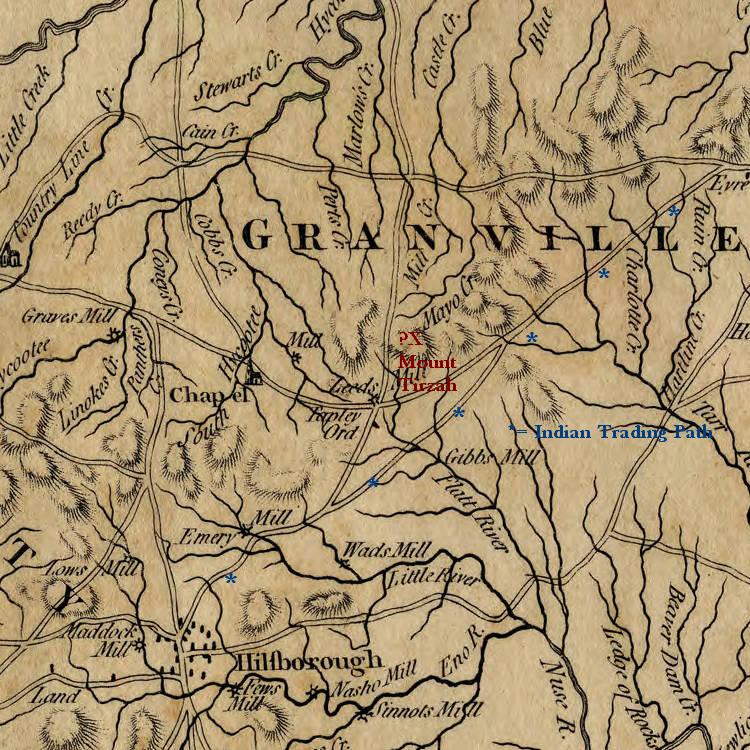
The ante-bellum period is defined as being that time between the Revolutionary War and the War Between The States or from 1800-1860. What was life like during this period at Mt. Tirzah? Though Stephen had died at the very end of the previous century (29 December 1799), his widow, Grizey, lived well into the new century, along with her brother, Thomas, and her sister-in-law, Ann. Most of the children still lived at the plantation, although some of the grandchildren would start to move away and even out of North Carolina, beginning the spread of the descendants.
Charles was listed as the postmaster of the Mt. Tirzah post office. Phillips, along with his uncle Thomas Phillips, would manage the store.
 [Southern Historical Collection]
Phillips son, Stephen, would move to Hillsborough where he owned a shoe store. Many letters between Phillips and his son are collected in the Southern Historical Collection in Chapel Hill.
Also preserved are many letters between Ann Moore, Grizey Moore and Throg’s Neck, N.Y., where much of the rest of the Moore family resided, as they remained in touch with the greater family at large. An example:


[Southern Historical Collection]
A wonderful book about this period, Ante-Bellum North Carolina – A Social History, by Guion Griffis Johnson was published by the University of North Carolina Press in 1937. Vicky Wells of the UNC press has kindly given me permission to quote sections of the book, which has long been out of print. Contained in this book are many excellent references about the Mt. Tirzah plantation life, as Johnson used Moore collections in the Southern Historical Collection extensively:
THE OVERSEER
Upon the skilful management of the slaves often depended much of the success of a plantation. Surly hands could defy an overseer, break a vast amount of equipment, and otherwise interrupt the plantation routine without seeming to do so.
Most of the large plantation owners employed overseers to assist in the management of the Negroes and the crops. . . .
An excellent overseer, or superintendent, as he was sometimes called, was difficult to find. The work was strenuous, the pay small, and the requisite personal qualities usually above those of the person willing to engage in such a profession. It was customary to furnish an overseer lodging and to pay him in one of three ways: a money wage payable in notes which might be converted into cash at a discount, a smaller money wage supplemented with a specific amount of provisions, or a share in the crop and certain specified provisions. The customary money wage in the last half of the ante-bellum period varied from $125 to $250.
The relation between Phillips Moore of Mount Tirzah in Person County and his overseer, Nathaniel Smith, during the planting year of 1819-1820 was typical of conditions on many a small plantation. In November, 1819, owner and overseer entered into the following agreement:
Said Smith undertakes to perform the duties of Overseer for said Moore under his particular advise & direction, to take charge of the hands, the work with them diligently, to assist in feeding the stock of every kind, with all care of the same that is requisite in all seasons of the year, to see that there is plenty of fire wood always provided at the door for the house fires, to take care of all the farming utensils of every description, and have them housed except when immediately in use, to repair fences, take care to prevent any damage or loss of any kind whatever, and to make up all loss time whatever, & find himself.
And said Moore for this part to pay unto said Smith two hundred Dollars or its value for the term of one Year.
To this agreement Smith added a proviso of his own, to which the owner agreed:
And we further agree that if any dispute does arrise which cannot be mutually settled we bind ourselves to leave it to three persons to be chosen by ourselves. . . .
Accustomed to keeping strict accounts at his country store, Moore also kept strict account of his overseer’s activities, charging him at the end of the year with having lost twenty-two and a third days from work. He set down each offense as it occurred so that at the end of the year he had an imposing list with which to confront the overseer: “Nathaniel Smith lost this day, his wife being sick. This day away about your pork. . . . Went away at a time I wanted you to work at tobacco . . . fatening hogs got out, you unconcerned, came & set down by fire. No care taken of tobacco stript the other night, at night a horse verry sick, paid no attention to him. Went to the Court house. . . . Went to muster. . . . Went to Mother in Law’s. . . . . Went fishing, left the plow & horse, & neglected the hands (corn verry foul .ch.d you $1). . . . . Thursday went to the Election . . . went to sale . . . went to General Muster. . . .” Taking out $14 for lost time, about $12 for provisions advanced, chiefly brandy, shoe repairing, and a barrel of flour, Moore discharged his part of the agreement by giving the overseer three notes for $58 each, and set about looking for another manager.
But the new overseer was little better. He was sick much of the time; he went to town on court days and attended elections; often he neglected to go to the remote fields when the people were at work there; and he finally moved away ten days before the expiration of his contract, leaving “my fences down in several places”
[Phillips Moore Papers, November 13, 1819 – December 20, 1821]
[Above taken from Ante-Bellum North Carolina, pp. 489-492]
In the same vein, Richard Stanford wrote on 15 February 1815 from Washington, DC to his wife, Mary, at Mt. Tirzah:
“Can you make some arrangement with your mother for the succeeding crop-I want to do something in that way, but I want an even, & equal one. I pay a large rent, you know, for the place.
Suppose I send down 2 or 3 hands & repair the fences, trim the orchard, etc. & then have a hand with Scipio to go on with the crop, what will be right in the division? If I had an overseer I would rather, but if a suitable overseer cannot be had, I would rather have none.”
[Richard Stanford Papers, North Carolina State Archives]


[Southern Historical Collection]
LIVING CONDITIONS OF THE SLAVES
“Negro cloth” was either plain, homespun, cotton for summer and wool for winter, dyed blue or brown and made on the plantation, or blue checked, osnaburgs bought from a local merchant or in Petersburg, Norfolk, or some northern city. . . .
On some plantations, the spinning, weaving, and sewing were done by slave women unable to do field work, but on others the master employed white women to do the work and the mistress herself sometimes helped. Phillips Moore of Person County regularly employed a white woman to spin, weave, and sew for his Negroes and a man to make their shoes. In 1803, for instance, he paid a Mrs. Hogue £3 for making Scipio “overalls and Jacoat.”
[Phillips Moore Papers: Memorandum Book, December 2, 1803]
Most Negroes were not content with the simple clothes their masters provided, and sought, whenever possible, to obtain a “Sunday best” with their own money. . . .
The Negro cabins, grouped together in a single or double row back of the master’s house, were made of clapboards or of poles chinked with clay. Each had a large fireplace and stone hearth where the family cooking was done, a table, some shelves, and perhaps a rude bed, a chest, and a few plantation-made chairs. It was a common practice for Negroes to sleep in a heap of rags or on a corn shuck mattress on the floor, or on a plank or chair.
[R.W. Gibbs, “Southern Slave Life,” North Carolina Standard, June 30, 1858.]
SLAVE HEALTH
On most plantations the young and the sick received special attention. Enceinte women usually worked at half task until the last few months of pregnancy when only a fourth task was required of them. Phillips Moore, of Person County, employed a Mrs. Bumpass in Chatham County to attend his slave Annica. He paid the midwife her expenses and 10 shillings. As a rule, no work was required of the mother until the infant was a month old. From that time until the child was two or three months old the mother returned to the quarters to suckle the infant. Later the nurse, usually a child, carried the baby into the field to the mother.
[Waste Book, January, 1796-December, 1803, in Phillips Moore Papers.]
THE SLAVE AND HIS MONEY
Since the slave had money in his pocket, he was a potential buyer, and slave money was as good as master’s money. Indeed, unless the planter kept his own store and required his slaves to buy of him, as did Ebenezer Pettigrew of Phelps Lake, the slave was more likely to patronize the small tradesman than was the planter, who frequently bought his supplies in large quantities at a distant market. The accounts of merchants frequently show, as did those of Phillips Moore of Person County, that the neighborhood slaves were in the habit of buying small articles. The Moore Account Book, 1810-1816, records, for instance, that “on the 26th. of Sept. Old Jim had little better than ½ pint of [of liquor] for white onions” and that on April 17 Scipio had “Shoe Leather, supposed to be abt. a balance for Tobacco bot. of him.”
[Moore Account Book, 1810-1816, in Phillips Moore Papers.]
SLAVE FAMILY LIFE
As important as money in the pocket in building up a wholesome morale among slaves was the master’s observance of family life among his black people. He gave each family a place to live; he issued rations by families; he encouraged slave marriages and respected the grief of a family when a member died. Some families built up a strong feel of solidarity and loyalty. . . .
In 1823 L. V. Hargis of Point Pleasant in Person County wrote the following note to Phillips Moore, giving permission for Ben to marry:
D.r Sir Your note by Ben the 25th Instant is before me stating – Ben had communicated to you his desire to take a wife among your negro women. If it meets my approbation. As it appears the boy wants a wife I make no objections & if he undertakes I hope he will not disgrace his Station.
[Phillips Moore Papers: L.V. Hargis to Phillips Moore, August 27, 1823.]
When slaves decided to marry, they went to their master, or to the overseer in the absence of the master, and signified their intention. The master might immediately ask the couple to join hands while he pronounced them man and wife or he might set a day for the ceremony. The wedding might take place in the quarters, the yard, or in the master’s kitchen, and the master might himself perform the ceremony or yield his place to a minister or to a religious leader from among the slaves. After a simple celebration with sweetened water and a meat stew, singing and dancing, the couple went to their new home, a cabin which the master assigned them.
Separation was equally casual. The marriage might be dissolved at the pleasure of either party or by the sale of one or both, being dependent, therefore, upon caprice or the necessity of their owners. The master, however, found it to his advantage to encourage marriage stability and to insist that his slaves abandon their African tradition of polygamy in favor of monogamy. After a certain slave named Samuel of a near-by plantation had lived with Mina, the slave of A. M. Lea of Caswell County, and had had five children by her, he quarreled with her, and bundling up his clothes, he started away, saying that he intended to part with her. Lea, however, compelled Samuel to leave the clothes until he obtained a written permit from his master sanctioning the separation.
[Above taken from Ante-Bellum North Carolina, pp. 524-525, 527, 532-536]
Much more information on slave life on the neighboring Stagville Plantation to the south on the Flat, Little and Eno Rivers is available at http://www.stagville.org/. Examples of two-story, four-room slave dwellings in Horton Grove can be toured as well as the Bennehan home. By 1860, the Bennehan-Cameron family owned almost 30,000 acres and nearly 900 slaves.
During the ante-bellum period, a free Negro named Thomas Day lived in nearby Milton, which is near the Person County – Caswell County – Virginia line. He was renowned far and wide as the best furniture and cabinet maker. For more information on Thomas Day, see the website:
http://www.rootsweb.ancestry.com/~ncccha/biographies/thomasday.html.

SANITATION AND HEALTH: NATIVE SIMPLES
The average ante-bellum family called a doctor only in an emergency or when every other curative means had failed. In 1832, for instance, when a certain child became ill Monday “with a puking and a severe pain in her head, I had her bled and sweated,” wrote her mother. But she still complained of a severe pain in her head and her mother put a blister on the back of the child’s neck. When the blister did not draw well and the child fell into a coma, her parents became alarmed and called a doctor Saturday afternoon, five days after her first attack.
Many a head of a family knew as well how to bleed or draw a blister as did a physician, and his wife, as has already been pointed out, was usually well informed in the knowledge of household remedies. Almost any account book of the ante-bellum period shows that the owner kept on hand a supply of the usual medicines. The Phillips Moore Account Book kept between 1805 and 1811 shows that the following medicines were purchased in Petersburg at various times: two bottles of essence of mustard, a asafetida, senna, opium, two ounces of sal ammonia, blistering plasters and salve, two bottles of sweet oil, and two pounds of copperas. Here was a variety of medicines sufficient to cure almost any ante-bellum complaint.
A great many families, however, could not send abroad for medicines; neither did they obtain them from the supply which every doctor always kept on hand. They relied, instead, upon herbs which grew in the fields and woods. Every granny and a great many housewives, as well, knew the various plants and their properties; knew how to gather and dry them, brew them into decoctions or pulverize them to be taken as powders. These were the “native simples,” so called because of the belief that every country produced a simple remedy for its diseases. A knowledge of their use still exists in a great many families today, especially among the Negroes and the rural whites. Almost any adult can recall having seen his grandmother gathering sage to be used in a tea to cure winter colds or catnip to brew for the baby’s colic.
[Above taken from Ante-Bellum North Carolina, pp. 752-753.]
Of course, we know that Stephen’s son, Portius Moore, was a physician. More research needs to be done to find out if he, too, used the medicines that were stocked in the Moore store and if he used the “native simples.” We do know that the Moores consulted with the famous Dr. Benjamin Rush in Philadelphia on several occasions, particularly regarding the paralysis of Ann Moore.