Showing posts with label West Point. Show all posts

Tuesday, April 16, 2013

Technology

I am a big fan of technology and genealogy is certainly easier now than it was 25 years ago.  Today we can search on Google, access databases such as Ancestry.com, and read blogs.


We used to be limited to writing letters instead of emails (which was much slower), visiting libraries instead of Google Search, and reading books instead of blogs.  Not that some of those methods are still helpful, such as reading earlier investigations in books, and searching microfilm and boxes of documents in libraries and archives.

Terri O'Neill is forever commenting on what a beautiful handwriting that Stephen Moore had, even transcribing documents for others.  But I want to tell you that Terri and I started all this before we had such technology.  We wrote letters.  Terri published her findings in her excellent  Moore, Stanford, Webb Chronicles before we had a blog.  I had always wanted to write a book on the Stephen Moore family, but with constant new information developing, a book quickly becomes dated and blogs can remain current.

Not only did Stephen Moore have a beautiful handwriting, but so does Terri and most of you have never seen it, because her work appears in printed form.  Here is a letter that Terri wrote me some 25 years ago about West Point.  Note her handwriting and her love for genealogy, when she said: "I wish I could devote more time to this stuff instead of mundane details like fixing meals & doing laundry!"


To see images above larger and more clearly, click on them and then choose "open image in a new tab."

Saturday, January 19, 2013

Trip to West Point in Search of Lt Col Stephen Moore’s Homesite

Since I am relatively new to David’s blogspot, Stephen Moore of Mt Tirzah Family, I will introduce myself. My name is Sandra Moore Shoffner and I am a 4th great-granddaughter of Stephen Moore. I am a recently retired medical/pharmaceutical editor. I grew up in Burlington and currently live in Mebane, both towns being in Alamance County, NC. Mt Tirzah in Person County is about a 45-minute drive from my home in Mebane. My 2nd great-grandmother, Sarah Harriet Moore (widow of Richard Henry Moore [son of Portius]) remarried and left Person County for Alamance County sometime after 1850 with her son, my great-grandfather, Henry Fletcher Moore. I am including the following three family photos for your information, top to bottom: Dr Henry Fletcher Moore (great-grandfather), Richard Alexander Moore (grandfather), and Richard Fletcher Moore (father):
My husband, Harry Shoffner, and I took a trip to the Hudson Highlands in New York State and to the United States Military Academy at West Point (October 2012) to see for ourselves the location of the original site of Stephen Moore’s Red House. In preparation for our trip, I researched everything I could find online concerning the Moore family at West Point and the history of West Point, plus all the family history researched and recorded by cousins Terri O’Neill, Steve Moore, and David Jeffreys. I also discovered several websites with additional information that proved invaluable, including TheMoores of West Point  and  Historic Structure’s Report, Fortress West Point 1777-1783 

I had corresponded with a retired Lt Col at West Point who agreed to meet us there, escort us onto the grounds, and help us find the homesite. But, as a backup, we signed up for an afternoon West Point tour through the West Point Visitors Center before we left North Carolina, just in case. We knew beforehand that the tour would not make a stop at the Target Hill Athletic Fields, the place our research had directed us to go to start our search. The tour did include a stop at the West Point Cemetery, which was on the hill directly above the athletic fields so we thought we could perhaps get a glimpse of the general area where the Red House had stood. We never caught up with the retired Lt Col I had corresponded with, despite several attempts, so we were basically on our own.

Since we had time to kill our first morning there, before our 2:00 scheduled tour, we decided to take a chance and drive to the guard station at the entrance to the West Point grounds. We had been told by the staff at The Thayer Hotel (where we were staying), at the Visitors Center, and on the West Point website that we would not be allowed to go onto the grounds unescorted. We decided it could not hurt to plead our case to the security guard on duty. We explained that we had driven all the way to New York from North Carolina to try and locate the original site of my 4th great-grandfather, Col Stephen Moore’s, Red House somewhere on the Target Hill Athletic Fields (pictured below).

We showed the guard a photo of the bronze plaque honoring Lt Col Stephen Moore that I had found on a website. I explained that we wanted very badly to locate the plaque for ourselves and photograph it, and also to walk around and try to locate a stream that was on the property. So, after a thorough search of our vehicle and on approval of our identification, we were told that we could go ahead and drive onto the property to conduct our search. We could not believe our good fortune!

We drove around and explored the academy grounds using a map I had downloaded from the USMA website. We had to drive carefully to avoid hitting any of the hundreds of cadets running, walking, and marching everywhere. The first thing we did after locating the athletic fields down by the Hudson River on River Road, was to roam the fields, searching for the stream that was documented to have flowed beside the Red House and emptied into the Hudson. We found the stream flowing out of the mountainside, just to the left of the field house, and running underneath the rugby field (see photo below).

We also took a photo from behind the stream looking out across the field and over to the fence where we eventually found the plaque. We are assuming (according to all the information I had gathered from my research and my correspondence with Terri)  that the house was located somewhere between the stream and the plaque location, which we later discovered was near our truck parked out on River Road (see black circle on photo below.)

After looking for the plaque and coming up empty-handed, we enlisted the help of two guys who were jogging past. We showed them the photo we had of the plaque and asked if they had ever seen it as they were jogging past the field. They volunteered to help us search and yelled that they had found it, buried under a bed of twigs. The twigs were arranged as if someone were planning to light a fire there (maybe a “hint” left by our elusive Lt Col). We found that strange, but brushed the twigs off and took a photograph of the plaque.


Harry took a photo of me standing with the plaque to show the relative position of the plaque to the fence, road, railroad track, and the river. The Hudson is just beyond the railroad track behind me, but is hidden in this view.

I was informed that members of the Moore family were there for a Moore family reunion in 1991, at which time they dedicated the site, planted a tree, and ordered the plaque. It seems that the original homesite is now the location of the new Anderson Rugby Complex and Field House that opened in 2007.

Our next stop was a drive back up River Road to an area overlooking the docks on the river to try for another view of the original site of the Red House in relation to the Hudson River. The view from there was absolutely breathtaking! I have placed a white circle on the photo below to show the approximate location of the homesite on the rugby field, just left of the field house.

Lastly, I took the photo below from Trophy Point to show the relative distance from the homesite on the left bank of the Hudson River directly across to Constitution Island on the right bank, an island which is part of the grounds of the United States Army Garrison, West Point. It was known as Martler’s Rock in colonial times and renamed Constitution Island in 1775.

The Hudson Highlands are gorgeous in October and I encourage other Stephen Moore descendants to make the trip--you won’t be disappointed! 

Friday, November 23, 2012

Col. John Moore of New York City


After two years of writing, editing, rewriting and re-editing, the entire article on Col. John Moore and his wife, Frances Lambert, has been published. It appears in two parts, in the New York Genealogical and Biographical RECORD: Vol. 143, Number 3, July 2012, and Number 4, October 2012. I hope all of you who are interested in family history will seek out these two issues from your library. Quite a few new discoveries about our Moore lineage have been made in the last 5 years or so, and I crammed as much of it into the article as space would allow.

Some of you have asked how to obtain copies of the article published in two issues of the RECORD. If they are not available in your local library, you can contact the New York Genealogical & Biographical Society RECORD, 36 West 44th Street, New York, NY 10036-8105. Single issues are $7.50 each. The website address is: www.newyorkfamilyhistory.org

The article is in Vol. 143, Number 3, July 2012, and Number 4, October 2012.

Terri Bradshaw ONeill
Colleyville, Texas

Sunday, October 21, 2012

Fortress West Point, 1778-1783

This Report is 76 pages long and contains very interesting and valuable information about West Point at the time the U.S. Government took over the property from the Moore family.  Following are two representative pages from the document.  Also contained are many pictures including maps.

Click on this link to view the entire report.


Monday, July 6, 2009

MOORE RESEARCH QUESTIONS

Doing research always leads to questions as well as answers. Below you will find questions that we would like the answers to. If you have an answer or a source, please leave it in the comments section below or email the answer to me (see Email your editor in the left sidebar). I will be pleased to enter additional questions you may have to this list, if you email me.

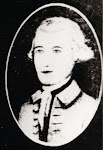
1-What is the origin of the Stephen Moore in uniform miniature?
2-Who was Julia, the actress, who may have been the mother of Robert?
3-Information on Dr. Portius Moore, the physician. Details about his education and practice. Supposedly, the chimney of his office has survived.
4-What was family life like among the children and grandchildren of Stephen Moore, Charles Moore, and Thomas Phillips from 1800 on, and did they live in a community still working together around Mt. Tirzah? We have some clues from the ledgers of the store. Was there also a community around Moore’s Mill, which had previously been Gibbons’s Mill, as folks tended to gather around a mill for news, help, and shared experiences? A lot of the answers to these questions may still be found in the Southern Historical Collection at the Wilson Library on the UNC Chapel Hill campus.
5-Who were the families around Mt. Tirzah that interacted with the Moores? For example, the Reades and the Dickins. There was an Osborne Jeffreys, and a Paul Jeffreys that frequently traded at the Mt. Tirzah store recorded in the ledgers; who were they?
6-How many slaves lived on the Mt. Tirzah plantation after 1800? What jobs did they perform? Where did they live? Who were they, by name, and were any given their freedom early?
7-Does anyone have a copy of the presentation that Dr. Bailey Webb gave on Ann Moore, who was the invalid sister of Stephen, that she gave at the 1991 Moore Reunion at West Point?
8-Is there a member of the Webb family that was sufficiently close to Dr. Bailey Webb that they could give us a biographical sketch? I remember her practicing in Durham when I was a child. Did one of you inherit her effects or papers? If not, do you know what happened to them?
ANSWER: I have found the papers in the Special Collections at Duke Univerisity Perkins Library. The papers have not been cataloged and are not available on microfilm. At the present time the collection is closed, pending cataloging. The collection is huge consisting of 5416 items (9.7 lin. ft.). David Jeffreys, 7-28-2009.
Author Webb, Bailey Daniel. Title Bailey Daniel Webb papers, 1845-2001 (bulk 1950s-2001) Location/Request Special Collections Library: Manuscripts 6th 24:B Location/Request Special Collections Library: Library Service Center, Manuscripts (Reading Room only) Library Service Center LSC
9-When was Moore’s mill operated by the Moores? Was it after Stephen’s death in 1799 and during the antebellum period? The Stephen Moore plantation did NOT extend far south enough to be on the Flat River, where the mill was located. Research project: Search deeds where mill was located between 1780 and 1850 to determine owners of the mill site at the Person County Courthouse Register of Deeds office.
10-Stephen Moore has hundreds and maybe thousands of descendants by now; there were several hundred in attendance at the West Point Reunion in 1991. The descendants live all over the country and perhaps the world, and certainly there are a number still in Person County. However, I am not aware of any descendants that live today on the original Stephen Moore Plantation property as it was in 1799. Perhaps some of the Reade family members still live on the northwestern part of the property, but I’m not sure. The Reade family occupied the Mt. Tirzah house into the 1970s and maybe the 1980s, before it was sold to Stephen Cox, the present owner, who has renovated it. QUESTION: Does any blood descendant live on the original plantation TODAY?
11-Was Stephen Moore, his estate, or members of his family ever paid for the West Point Property by the United States government and/or the North Carolina government?
12-Regarding Stephen Moore, I had written in 1983 "At the end of the century, on December 29, 1799, he died at Stagville at the home of Richard Bennehan. It is interesting to speculate why he was there when he died. Had he gone there during the festive season between Christmas and New Year’s and fallen suddenly ill? Was he there on business? Or perhaps Stephen was already ill and had gone to Stagville in search of a doctor since Stagville was a larger plantation than his own and may have had a doctor in residence." This may be true or it may be family folklore, but I've always thought it rang true. So far, I don't know of any documentation in the Bennehan-Cameron Papers around 1799, that are located in the "Southern Historical Collection" and the "North Carolina State Archives" or anywhere else for that matter, as proof.
13-Would you and/or other members of your family be interested in learning more about our Moore ancestry using DNA testing? If so, let me know, and perhaps we could get together for a lower cost group rate. For example, it might solve the question: did Robert have a different mother from all the other children of Stephen Moore? You might remember the recent interest inquiry and interest by the descendants of Thomas Jefferson. For more information, see: http://dna.ancestry.com/learnMore.aspx. There are other services for DNA heritage testing as well.

Active Moore research continues among several of our family members leading to new discoveries and knowledge. Won’t you join them?

David E. Jeffreys

Monday, June 22, 2009

Stephen Moore 1734 - 1799


Stephen Moore is certainly one of the favorite sons of Person County, North Carolina. He was awarded original land grants in the area, now known as Mount Tirzah, a name of Stephen Moore’s own choosing. He came to this high promontory and built his home in 1778, just prior to the Revolutionary campaigns in the southern theater of the war and became involved in the war himself, the only member of the large Moore family not to remain loyal to the crown.
Stephen Moore was very patriotic to the cause of the American independence and led a group of North Carolina militia to fight in the Battle of Camden (South Carolina) on August 16, 1780. It was a devastating defeat for Horatio Gates and the militia at the hands of Charles Cornwallis. Stephen Moore and 130 other men were taken prisoner to Charles Town. On May 18, 1781, from the prison ship Torbay in Charles Town Harbour, Stephen Moore wrote a letter to Major General Nathaniel Greene in which he said, “We just beg leave to observe that should it fall to the lot of all, or any of us to be made victims, agreeable to the menances therein contain’d, we have only to regret that our blood cannot be disposed of more to the advancement of the Glorious Cause to which we have adher’d.”
On February 26, 1781, several months earlier, General Nathaniel Greene had camped out at Col. Moore’s home, which was shortly before Greene met Cornwallis at Guilford Court House in the March battle. (see comment #2 below and the post: Col. Moore of Caswell County, NC: Stephen or William?)
In 1783, Stephen Moore petitioned the new government to buy his property at West Point in New York which Gen. George Washington had used during the Revolutionary War as his headquarters. There was already speculation that the government needed this land because of its strategic location on the Hudson River. In a letter in which Stephen Moore was trying to collect money from the now bankrupt U. S. he said, “Had my conduct during the struggles of my Country, proved me an active adversary, I must have silently bewailed the evils, both of banishment & confiscation, and tho I claim no merit for my feeble exertions in the hours of danger, neither can I be persuaded I deserve my present chastisement.”
In October 1783, Moore’s land at West Point was surveyed showing a total of 1617 acres. On a map from the National Archives can be seen the Red House (also known as Moore’s Folly) north of the bend in the river opposite Martler’s Rock. It was the Red House that was used both by the loyalist Moore Family to escape the trials of war in New York City and as headquarters of General Washington about the time of the treason of John Andre and Benedict Arnold. Finally on July 12, 1790, Henry Knox representing the U. S. government and Stephen Moore signed an agreement selling the West Point property to the government.
Stephen Moore had inherited the West Point property from his father, Col. John Moore. Known as Moore’s Folly, it had probably been named Moore’s Fawley, after the ancestral estate of South Fawley Manor in Berkshire County, England built in 1600 by Sir Francis Moore. [Note: There is now some doubt that Honorable John Moore was descended from Francis Moore at Fawley, but more likely from a Moore family in London. See footnote.] Stephen was the 17th child of the union of Col. John Moore (August 11, 1686 – October 29, 1749 and Frances Lambert (who died on March 21, 1782 in her ninetieth year) who were married in 1714.
Stephen Moore was born in New York City on October 30, 1734. In 1754 he was apprenticed to the Hon. John Watts, contractor for army supplies and a N.Y. merchant and member of his Majesty’s Council. Also in 1754, Stephen was commissioned in the N.Y. Regiment under Col. Oliver DeLancey. He volunteered for the French and Indian War in 1756, and the following year received a lieutenant’s commission in DeLancey’s Provincial Regiment. Then he was appointed provision contractor for the British Army. After the war he was rewarded the post of Deputy Paymaster General of Canada.
Stephen continued to live in Canada where he was a sea merchant (like his father before him) in Quebec. He was a member of “Burgess and Guild,” a sea merchant’s fraternal order in Glasgow, Scotland. As a sea merchant, he operated the Bonnie Lass and Bonnie Dundee which were routed between Glasgow, Scotland and Quebec with stops in Jamaica and Barbados. He entered the lumber trade with partner Hugh Finlay (the Postmaster of Quebec).
On Christmas Day, 1768, Stephen married Grizey Phillips (Feb. 18, 1748 – Jan. 15, 1822) and on Nov. 12, 1769, son John was born in Quebec. The infant John died the following year on Sept. 7, 1770. Stephen went bankrupt and left Canada in 1770 returning to N. Y.  Robert was born Nov. 5, 1762, before Stephen's marriage to Grizey and therefore, is the stepson of Grizey. (More information about Robert's birth is in another article on this blog.)
From 1765 to 1775, Stephen Moore’s official residence was listed on town reports of Cornwall, N. Y. (near West Point). Their son Phillips (born July 12, 1771) and daughter Frances (Dickens) (born Nov. 5, 1773) were born in New York. In 1775, Stephen moved his family to Tally-Ho in Granville County, N.C. where daughter Ann was born (Jan. 12, 1777). A fire in lower Manhattan, a consequence of the war, burned Trinity Church and the Moore home to the ground.

Stephen obtained in Mount Tirzah land in Jan. 1777 and built his home in 1778 (the date exists on a stone in the basement stairs), a beautiful structure on the Mount Tirzah hilltop. The home is believed to be the second oldest in Person County, with the original part of the Lea home being older. Stephen continued acquiring land until he had a plantation of approximately 3000 acres. His brother, Charles and his brother-in-law, Thomas Phillips, also moved to Mount Tirzah. Stephen petitioned the federal government for a post office at Mount Tirzah and was successful in having his brother, Charles, named postmaster.
Approximately a quarter mile to the south of his home, Stephen returned to merchandizing by building a store, which became an important place of trade, as he was the only merchant within a ten to twelve mile radius, prior to 1800. This country store was probably the local gathering spot for the latest news of the region and more distant places. In addition to buying and selling with the local farmers, Stephen dealt with more distant merchants such as Richard Bennehan at Stagville, N.C., and with merchants of the major trading and distribution point of the times in Petersburg, Virginia.
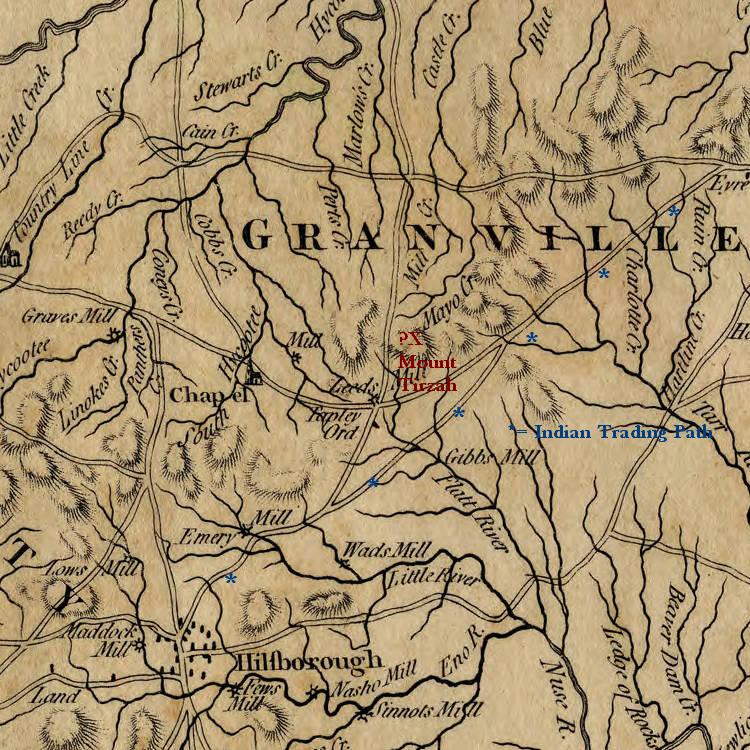
There was a road from Mount Tirzah to Raleigh which passed through the plantation of Richard Bennehan (later the immense and famous Cameron Plantation). At Stagville, Richard Bennehan’s home, this road bisected the old Indian Trading Path, which was the major north-south route of commerce of the times. The Indian Trading Path extended from Petersburg, Virginia, in the north to Salisbury, North Carolina, on the Yadkin River in the southwest.  (I-85 roughly follows the Indian Trading Path.)
Evidence from the Stephen Moore papers suggests that his brother-in-law, Thomas Phillips, and his son, Phillips Moore, participated in the day to day running of the store and keeping the day books and ledgers. Most of the ledger books were in the hands of Phillips Moore, and there is one entry that suggests that his uncle, Thomas, was not an able bookkeeper, which states as follows: “There are so many wrong entrys in the Ledger made by my Uncle Thos. Phillips, that the day book must be again posted or the accts. cannot be properly adjusted. 13th Jan. 1816. Phillips Moore (signed).”
The Mount Tirzah store made many daily transactions with the local farmers and with the merchants in Petersburg, and there are entries in the day books which keep a running account of amounts drawn and credited. In Petersburg on 8 February, 1797, Phillips Moore “Bought of Eleazer F. Backus” various sundry items such as pepper, allspice, needles, nutmegs, a fine comb, cloth, hammer, nails, awls, a lock, paper, calico material, scissors, coffee, chocolates, salt, sugar, a hat, a trunk, a wagon screw, and other items for which he paid £17.8.8.
Another transaction with Mr. Backus produced cotton, tea, sugar, paper, scissors, cloth, a blanket, 20 bushes of salt and linen for which he traded corn and pork. This last transaction took place on 23 December 1796, which makes one wonder if he made it home in time for Christmas as Petersburg was more than a hundred miles away on the old Indian Trading Path.
The Mount Tirzah store also rented for hire the employment of the Moore family slaves to the neighboring farmers to help with various farm work. There was considerable business done in potatoes, wheat, and corn. However, the Mount Tirzah store also dealt with a refined product of the grains, that of liquor as many references to brandy and rum would indicate.
Among his other business ventures was a mill which was formerly named Gibbon’s and pre-dates 1769. He also owned a brick kiln. So we see Stephen Moore as a diversified owner of several business interests of which he probably left the day-to-day management to various members of his family. This left him time for an active interest in the Revolutionary War and Politics.
Stephen’ son Marcus was born on Nov. 27, 1780 while he was being held prisoner in Charles Town. Stephen was finally released on June 22, 1781. He was appointed Commissioner for Specific Taxes in 1781 and superintendent Commissioner of Hillsborough District in 1782. On October 15, 1782 another son, Portius, was born.
From 1783 to 1792, Stephen was Deputy Quartermaster General of Army (under Col. Robert Burton, Quartermaster General of N.C.) which is where the title of “General” Stephen Moore comes from. Actually his highest rank was Lt. Col. In 1786 and 1787, he was nominated as representative to Congress, but was not elected.
Two more sons were born: Cadmus on June 30, 1787 and Samuel on June 15, 1789.
Even though Stephen successfully petitioned the bankrupt U.S. government to buy his West Point property in 1790, there is question as to whether he ever collected the 11,085 dollars.
On December 15, 1794, Sidney was born.
At the end of the century, on December 29, 1799, he died at Stagville at the home of Richard Bennehan. It is interesting to speculate why he was there when he died. Had he gone there during the festive season between Christmas and New Year’s and fallen suddenly ill? Was he there on business? Or perhaps Stephen was already ill and had gone to Stagville in search of a doctor since Stagville was a larger plantation than his own and may have had a doctor in residence.
Stephen Moore left quite an impact on Person County, through his activities politically, in the war, economically, and with the many descendants, some of which still live and own land in Person County.
Sources: This article was written by the great-great-great-great-grandson of Stephen Moore for the Person County History, vol. II. Sources include Duke University Archives; Southern Historical Collection, U.N.C.; N.C. State Archives; West Point Library; Miami Public Library (Genealogy Room); Person County Records; Mount Tirzah home and graveyard; and a bibliography of books and articles too numerous to mention.-- David E. Jeffreys, Jr. - written for the Person County Heritage, vol. II, 1983. © Updated May 2010.


_____________________________________________
Footnote: See "A Corrected Lineage of Hon. Moore of South Carolina and Pennsylvania" by Terri Bradshaw O'Neill (Pennsylvania Genealogical Magazine, Vol. 44 (2005) pp. 101-121).