Showing posts with label Richard Stanford. Show all posts

Thursday, July 9, 2009

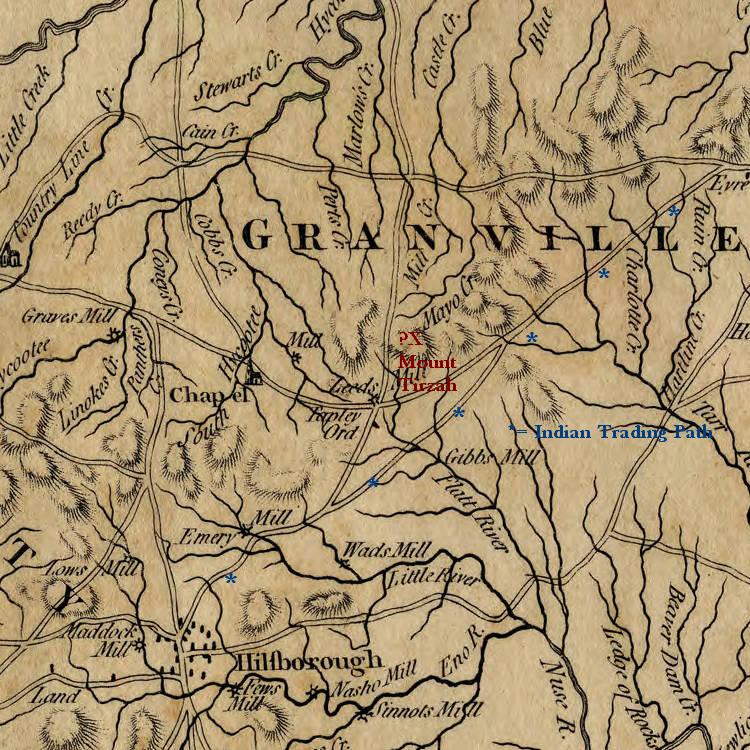
The Ante-Bellum Mount Tirzah Plantation

By David E. Jeffreys, written in July, 2009 ©
The ante-bellum period is defined as being that time between the Revolutionary War and the War Between The States or from 1800-1860. What was life like during this period at Mt. Tirzah? Though Stephen had died at the very end of the previous century (29 December 1799), his widow, Grizey, lived well into the new century, along with her brother, Thomas, and her sister-in-law, Ann. Most of the children still lived at the plantation, although some of the grandchildren would start to move away and even out of North Carolina, beginning the spread of the descendants.

Charles was listed as the postmaster of the Mt. Tirzah post office. Phillips, along with his uncle Thomas Phillips, would manage the store.

[Southern Historical Collection]
Phillips son, Stephen, would move to Hillsborough where he owned a shoe store. Many letters between Phillips and his son are collected in the Southern Historical Collection in Chapel Hill.

Also preserved are many letters between Ann Moore, Grizey Moore and Throg’s Neck, N.Y., where much of the rest of the Moore family resided, as they remained in touch with the greater family at large. An example:

[Southern Historical Collection]

A wonderful book about this period, Ante-Bellum North Carolina – A Social History, by Guion Griffis Johnson was published by the University of North Carolina Press in 1937. Vicky Wells of the UNC press has kindly given me permission to quote sections of the book, which has long been out of print. Contained in this book are many excellent references about the Mt. Tirzah plantation life, as Johnson used Moore collections in the Southern Historical Collection extensively:

THE OVERSEER
Upon the skilful management of the slaves often depended much of the success of a plantation. Surly hands could defy an overseer, break a vast amount of equipment, and otherwise interrupt the plantation routine without seeming to do so.
Most of the large plantation owners employed overseers to assist in the management of the Negroes and the crops. . . .
An excellent overseer, or superintendent, as he was sometimes called, was difficult to find. The work was strenuous, the pay small, and the requisite personal qualities usually above those of the person willing to engage in such a profession. It was customary to furnish an overseer lodging and to pay him in one of three ways: a money wage payable in notes which might be converted into cash at a discount, a smaller money wage supplemented with a specific amount of provisions, or a share in the crop and certain specified provisions. The customary money wage in the last half of the ante-bellum period varied from $125 to $250.
The relation between Phillips Moore of Mount Tirzah in Person County and his overseer, Nathaniel Smith, during the planting year of 1819-1820 was typical of conditions on many a small plantation. In November, 1819, owner and overseer entered into the following agreement:

Said Smith undertakes to perform the duties of Overseer for said Moore under his particular advise & direction, to take charge of the hands, the work with them diligently, to assist in feeding the stock of every kind, with all care of the same that is requisite in all seasons of the year, to see that there is plenty of fire wood always provided at the door for the house fires, to take care of all the farming utensils of every description, and have them housed except when immediately in use, to repair fences, take care to prevent any damage or loss of any kind whatever, and to make up all loss time whatever, & find himself.

And said Moore for this part to pay unto said Smith two hundred Dollars or its value for the term of one Year.

To this agreement Smith added a proviso of his own, to which the owner agreed:

And we further agree that if any dispute does arrise which cannot be mutually settled we bind ourselves to leave it to three persons to be chosen by ourselves. . . .

Accustomed to keeping strict accounts at his country store, Moore also kept strict account of his overseer’s activities, charging him at the end of the year with having lost twenty-two and a third days from work. He set down each offense as it occurred so that at the end of the year he had an imposing list with which to confront the overseer: “Nathaniel Smith lost this day, his wife being sick. This day away about your pork. . . . Went away at a time I wanted you to work at tobacco . . . fatening hogs got out, you unconcerned, came & set down by fire. No care taken of tobacco stript the other night, at night a horse verry sick, paid no attention to him. Went to the Court house. . . . Went to muster. . . . Went to Mother in Law’s. . . . . Went fishing, left the plow & horse, & neglected the hands (corn verry foul .ch.d you $1). . . . . Thursday went to the Election . . . went to sale . . . went to General Muster. . . .” Taking out $14 for lost time, about $12 for provisions advanced, chiefly brandy, shoe repairing, and a barrel of flour, Moore discharged his part of the agreement by giving the overseer three notes for $58 each, and set about looking for another manager.
But the new overseer was little better. He was sick much of the time; he went to town on court days and attended elections; often he neglected to go to the remote fields when the people were at work there; and he finally moved away ten days before the expiration of his contract, leaving “my fences down in several places”
[Phillips Moore Papers, November 13, 1819 – December 20, 1821]
[Above taken from Ante-Bellum North Carolina, pp. 489-492]

In the same vein, Richard Stanford wrote on 15 February 1815 from Washington, DC to his wife, Mary, at Mt. Tirzah:
“Can you make some arrangement with your mother for the succeeding crop-I want to do something in that way, but I want an even, & equal one. I pay a large rent, you know, for the place.
Suppose I send down 2 or 3 hands & repair the fences, trim the orchard, etc. & then have a hand with Scipio to go on with the crop, what will be right in the division? If I had an overseer I would rather, but if a suitable overseer cannot be had, I would rather have none.”
[Richard Stanford Papers, North Carolina State Archives]


[Southern Historical Collection]

LIVING CONDITIONS OF THE SLAVES
“Negro cloth” was either plain, homespun, cotton for summer and wool for winter, dyed blue or brown and made on the plantation, or blue checked, osnaburgs bought from a local merchant or in Petersburg, Norfolk, or some northern city. . . .
On some plantations, the spinning, weaving, and sewing were done by slave women unable to do field work, but on others the master employed white women to do the work and the mistress herself sometimes helped. Phillips Moore of Person County regularly employed a white woman to spin, weave, and sew for his Negroes and a man to make their shoes. In 1803, for instance, he paid a Mrs. Hogue £3 for making Scipio “overalls and Jacoat.”
[Phillips Moore Papers: Memorandum Book, December 2, 1803]
Most Negroes were not content with the simple clothes their masters provided, and sought, whenever possible, to obtain a “Sunday best” with their own money. . . .
The Negro cabins, grouped together in a single or double row back of the master’s house, were made of clapboards or of poles chinked with clay. Each had a large fireplace and stone hearth where the family cooking was done, a table, some shelves, and perhaps a rude bed, a chest, and a few plantation-made chairs. It was a common practice for Negroes to sleep in a heap of rags or on a corn shuck mattress on the floor, or on a plank or chair.
[R.W. Gibbs, “Southern Slave Life,” North Carolina Standard, June 30, 1858.]

SLAVE HEALTH
On most plantations the young and the sick received special attention. Enceinte women usually worked at half task until the last few months of pregnancy when only a fourth task was required of them. Phillips Moore, of Person County, employed a Mrs. Bumpass in Chatham County to attend his slave Annica. He paid the midwife her expenses and 10 shillings. As a rule, no work was required of the mother until the infant was a month old. From that time until the child was two or three months old the mother returned to the quarters to suckle the infant. Later the nurse, usually a child, carried the baby into the field to the mother.
[Waste Book, January, 1796-December, 1803, in Phillips Moore Papers.]

THE SLAVE AND HIS MONEY
Since the slave had money in his pocket, he was a potential buyer, and slave money was as good as master’s money. Indeed, unless the planter kept his own store and required his slaves to buy of him, as did Ebenezer Pettigrew of Phelps Lake, the slave was more likely to patronize the small tradesman than was the planter, who frequently bought his supplies in large quantities at a distant market. The accounts of merchants frequently show, as did those of Phillips Moore of Person County, that the neighborhood slaves were in the habit of buying small articles. The Moore Account Book, 1810-1816, records, for instance, that “on the 26th. of Sept. Old Jim had little better than ½ pint of [of liquor] for white onions” and that on April 17 Scipio had “Shoe Leather, supposed to be abt. a balance for Tobacco bot. of him.”
[Moore Account Book, 1810-1816, in Phillips Moore Papers.]

SLAVE FAMILY LIFE
As important as money in the pocket in building up a wholesome morale among slaves was the master’s observance of family life among his black people. He gave each family a place to live; he issued rations by families; he encouraged slave marriages and respected the grief of a family when a member died. Some families built up a strong feel of solidarity and loyalty. . . .
In 1823 L. V. Hargis of Point Pleasant in Person County wrote the following note to Phillips Moore, giving permission for Ben to marry:
D.r Sir Your note by Ben the 25th Instant is before me stating – Ben had communicated to you his desire to take a wife among your negro women. If it meets my approbation. As it appears the boy wants a wife I make no objections & if he undertakes I hope he will not disgrace his Station.
[Phillips Moore Papers: L.V. Hargis to Phillips Moore, August 27, 1823.]

When slaves decided to marry, they went to their master, or to the overseer in the absence of the master, and signified their intention. The master might immediately ask the couple to join hands while he pronounced them man and wife or he might set a day for the ceremony. The wedding might take place in the quarters, the yard, or in the master’s kitchen, and the master might himself perform the ceremony or yield his place to a minister or to a religious leader from among the slaves. After a simple celebration with sweetened water and a meat stew, singing and dancing, the couple went to their new home, a cabin which the master assigned them.
Separation was equally casual. The marriage might be dissolved at the pleasure of either party or by the sale of one or both, being dependent, therefore, upon caprice or the necessity of their owners. The master, however, found it to his advantage to encourage marriage stability and to insist that his slaves abandon their African tradition of polygamy in favor of monogamy. After a certain slave named Samuel of a near-by plantation had lived with Mina, the slave of A. M. Lea of Caswell County, and had had five children by her, he quarreled with her, and bundling up his clothes, he started away, saying that he intended to part with her. Lea, however, compelled Samuel to leave the clothes until he obtained a written permit from his master sanctioning the separation.
[Above taken from Ante-Bellum North Carolina, pp. 524-525, 527, 532-536]

Much more information on slave life on the neighboring Stagville Plantation to the south on the Flat, Little and Eno Rivers is available at http://www.stagville.org/. Examples of two-story, four-room slave dwellings in Horton Grove can be toured as well as the Bennehan home. By 1860, the Bennehan-Cameron family owned almost 30,000 acres and nearly 900 slaves.

During the ante-bellum period, a free Negro named Thomas Day lived in nearby Milton, which is near the Person County – Caswell County – Virginia line. He was renowned far and wide as the best furniture and cabinet maker. For more information on Thomas Day, see the website:

http://www.rootsweb.ancestry.com/~ncccha/biographies/thomasday.html.


SANITATION AND HEALTH: NATIVE SIMPLES
The average ante-bellum family called a doctor only in an emergency or when every other curative means had failed. In 1832, for instance, when a certain child became ill Monday “with a puking and a severe pain in her head, I had her bled and sweated,” wrote her mother. But she still complained of a severe pain in her head and her mother put a blister on the back of the child’s neck. When the blister did not draw well and the child fell into a coma, her parents became alarmed and called a doctor Saturday afternoon, five days after her first attack.
Many a head of a family knew as well how to bleed or draw a blister as did a physician, and his wife, as has already been pointed out, was usually well informed in the knowledge of household remedies. Almost any account book of the ante-bellum period shows that the owner kept on hand a supply of the usual medicines. The Phillips Moore Account Book kept between 1805 and 1811 shows that the following medicines were purchased in Petersburg at various times: two bottles of essence of mustard, a asafetida, senna, opium, two ounces of sal ammonia, blistering plasters and salve, two bottles of sweet oil, and two pounds of copperas. Here was a variety of medicines sufficient to cure almost any ante-bellum complaint.
A great many families, however, could not send abroad for medicines; neither did they obtain them from the supply which every doctor always kept on hand. They relied, instead, upon herbs which grew in the fields and woods. Every granny and a great many housewives, as well, knew the various plants and their properties; knew how to gather and dry them, brew them into decoctions or pulverize them to be taken as powders. These were the “native simples,” so called because of the belief that every country produced a simple remedy for its diseases. A knowledge of their use still exists in a great many families today, especially among the Negroes and the rural whites. Almost any adult can recall having seen his grandmother gathering sage to be used in a tea to cure winter colds or catnip to brew for the baby’s colic.
[Above taken from Ante-Bellum North Carolina, pp. 752-753.]

Of course, we know that Stephen’s son, Portius Moore, was a physician. More research needs to be done to find out if he, too, used the medicines that were stocked in the Moore store and if he used the “native simples.” We do know that the Moores consulted with the famous Dr. Benjamin Rush in Philadelphia on several occasions, particularly regarding the paralysis of Ann Moore.

Thursday, July 2, 2009

Stanford Family Cemetery in Orange County

STANFORD (MARY MOORE STANFORD) FAMILY CEMETERY


Location - In Bingham Township west of White Cross Road (SR #1951) in a remote and heavily wooded area on private land. On a rise 500 ft west of a field on the Atwater farm, which is at 804 White Cross Road. The cemetery is listed on the Orange County GIS system as PIN 9737-73-9241.Coordinates: 35d 52m 28.0s N; 79d 12m 35.0s W (See location map below.)
Survey - Date of 1970s visit not given. Milton Forsyth visited and photographed the cemetery in February 2005 courtesy of Don and Warren Atwater who allowed him access across their land and provided directions.
Graves, Marked [1970s]
- There were 3 or 4 marked graves.
Graves, Unmarked [1970s]
- There were 7 or 8 unmarked graves.
Status [2005]
- The cemetery originally stood near an old house, the remains of which was not readily evident in the current heavy woodland, but it is to the east of an old, now overgrown, roadbed. It had at one time been enclosed by a barbed-wire fence which is now almost gone. Unattended and covered with periwinkle, pinestraw and leaves with some small trees growing on the cemetery. A fine monument and some new stones were erected in the mid-1900s.
Comment: In 2009 Terri Bradshaw O'Neill of Colleyville, TX provided information that the cemetery was established by a 1909 deed from Thomas A. Atwater & wife, Isa, to James O. Webb, Trustee, and his successor for a consideration of $1.00, setting off 6/100's of an acre "for the purpose of preserving the Burial Ground of his ancestors." The description says, "This Cemetery is situated on Great Uncle Saurin Stanford's place." [Orange Co. Deed Book 107:220] She noted that the monument was dedicated on 17 July 1949 and was probably arranged for by Ralph H. Stanford of Burlington, NC. She furnished several photographs of the ceremony.

Above information courtesy of http://cemeterycensus.com/nc/orng/cem275.htm. Go to the website for the names of those interred and the photographs of their tombstones and monument.

Map Location of Stanford Family Cemetery

Editors Note: Honorable Richard Stanford, member of Congress, and husband of Mary Moore Stanford, died in office in Washington, DC on April 9, 1816, and was buried there in the Historic Congressional Cemetery.

Wednesday, July 1, 2009

The Richard Stanford “Silver Dollar” Story

Analysis of a Family Tradition:
The Richard Stanford “Silver Dollar” Story
by Terri Bradshaw O’Neill, 1999 ©

The story has been passed down in one branch of the family from the time of Mary Moore Stanford (1778-1851), daughter of Stephen Moore and wife of the Hon. Richard Stanford (1767-1816). Some of the salient points of the story are that Congressman Richard Stanford, having been elected to the first Congress, was Chairman of the Finance Committee and as a result, was instrumental in the design and first coining of the U. S. silver dollar, and determined the weight of the silver content by collecting specimens of the Spanish milled dollar in circulation from all thirteen colonies. He had them weighed and the average silver content was found to be 374 1/4 grains of silver and that is what he decided the weight of our silver dollars should be, though others argued that evening out the weight to 370 would simplify matters. The story continues to relate that, being a Quaker, Stanford’s principles caused him to declare, “Pay what thou owest”, and his estimation of the worth of the dollar prevailed.

The problems are in the time line.
· The First Congress was held in New York City in 1789.
· The Mint was established in Philadelphia in 1792. No silver dollars were struck until 1794.
· Richard Stanford was first elected to the House in 1797, and he took his seat in the Fifth Congress in May, 1797, at Philadelphia. While the Senate had what was called a Finance Committee, the House had a Ways and Means Committee. Richard Stanford’s name does not appear on that committee in the Annals of Congress. It seems unlikely that a freshman congressman would attain such a position.

In addition to the problems of the time line, there is the assertion that Richard Stanford was a Quaker. While he must surely have counted Quakers among his friends, acquaintances and constituents, it is not likely that he was a Quaker himself, for these reasons:
· Richard Stanford left many letters, some of which discussed his religious beliefs and even his doubts regarding religion
· It was the practice of Quakers to use the pronouns “thee” and “thou”; they also expressed dates by saying “the 4th day of the 3rd month...” rather than using the name of the months. Richard Stanford never did this.
· He was a slave owner
· He gave sworn testimony as a member of Congress, Quakers affirmed
· His will begins “In the name of God, Amen...”, a form not used by Quakers

I suspect that the story is apocryphal and was used to illustrate the fundamental integrity of our honorable forebear, Richard Stanford. If we consider the time and place that Congressman Stanford took his seat in the House of Representatives, and recall the names of his contemporaries and the leaders of government, we can begin to understand how such a family legend could have been polished and embellished over the ensuing generations. The mere mention of the names of Washington, Jefferson, Hamilton and so many others of the galaxy then assembled in Philadelphia in those early years of Richard Stanford’s career in the House, would have struck awe in his listeners. They must have been enthusiastically discussed and celebrated in every generation following him. Congressman Stanford’s tales of Philadelphia and Washington would have been told and retold with the pride of knowing that their father or grandfather had been there in those formative years. He had known, worked, socialized and had mutual interests with the most important and influential men of their time. He grew in experience and statesmanship and reputation in his own right. It was surely at the time of his first term of office in Philadelphia that Richard Stanford made the acquaintance of Dr. Benjamin Rush, from whom he later sought medical advice for his sister-in-law, Ann Moore. Dr. Rush was a Signer of the Declaration of Independence and had treated another member of the Moore clan in 1793. During Philadelphia’s Yellow Fever epidemic of that year, Dr. Rush treated Rebecca Moore Smith, daughter of William Moore and wife of Rev. William Smith, Provost of the College of Philadelphia. From 1797 until his death in 1813, Benjamin Rush was the treasurer of the U. S. Mint in Philadelphia. Is this obscure connection the grain of sand that became the pearl of family lore?

Tuesday, June 30, 2009

The Honorable Richard Stanford, Congressman

The Honorable Richard Stanford, Congressman
By Terri Bradshaw O’Neill ©

Remarkably little has been written about Richard Stanford (1767-1816), who represented the citizens of Orange county, North Carolina, in the United States House of Representatives from 1797 until his death in 1816. His ten terms in office spanned the Presidencies of John Adams, Thomas Jefferson, and James Monroe. During the period he was a Congressman, momentous events were occurring on the world stage as well as in the United States, most notable being the War of 1812. There is, of course, a paragraph in the Biographical Directory of Members of Congress. A few newspaper articles detail his political career. A fairly long sketch of Richard Stanford appeared in the Greensboro Daily News of 13 July 1941, written by Archibald Henderson. Samuel L. Adams of South Boston, VA, was a member of the Virginia Senate and a great-grandson of Richard Stanford’s. Adams took an early interest in his ancestor and wrote a series of letters to editors of newspapers, and biographical sketches beginning in 1901 and culminating in a sketch written in 1915. Most of these articles feature highlights of Richard Stanford’s career and accomplishments in Congress. These articles furnish a reasonable idea of his character and his political philosophy, indicating a strong belief in fiscal responsibility by Congress and the relatively new government. Richard Stanford was certainly in some measure instrumental in the formative years of our country’s development, but the details of his life and career for too long have been neglected.

Probably the most reliable source concerning Stanford’s early life and forebears is Henry Howland Crapo’s Certain Comeoverers, a well-written and entertaining family history published in 1912.1 There are, however, some gaps and discrepancies in the combined material which beg examination. Further, Richard Stanford’s letters reveal much more of his personality than has previously been shown, and relate some insight into his opinions regarding events large and small.

Some of what has been written about Richard Stanford and the Stanford family in Dorchester county, Maryland, is certainly in error. An oft-repeated story is that Hon. Richard Stanford was the third of the name in successive generations, the first Richard arriving in Maryland from Scotland in 1633 aboard the Primrose. The second Richard was a plantation owner, and according to Crapo’s Certain Comeoverers, was born 18 Jan 1743. The span of 90 years makes it highly unlikely that the second Richard was the son of the immigrant Richard. However, it is probable that the second Richard was the father of Hon. Richard Stanford who was born 2 March 1767.2 Mr. Crapo makes a strong case for the elder Richard Stanford’s parents to have been William and Elizabeth Stanford. Dorchester county land records and the 1759 will of Elizabeth Stanford seem to corroborate Mr. Crapo’s speculation.

Dorchester county land records show that a William Stanford and both Richard Stanford and Richard Stanford, jr. witnessed the sale of some land in July of 1785. Then, according to Certain Comeoverers, in the fall of 1785, the elder Stanford loaded a ship with the produce of his plantation. Taking his two young sons, Algernon S. and Clement, Richard set out for the market at Baltimore. A storm carried the ship out to sea, where Richard Stanford died, then the ship made the port of Norfolk, Virginia, where he was buried. The unscrupulous captain confiscated the cargo for himself and stranded the two Stanford boys there until their older half-brother, Richard, retrieved them.

It is unclear where young Richard Stanford was educated, but he apparently attended college. The name Richard Stanford of Dorchester county appears on the subscription list for the establishment of Washington College in Kent county in 1782.3 Perhaps this is where Richard received his education. It’s certainly an enticing possibility.

Young Richard Stanford first appears in Orange county, NC, records in 17884 and he opened his academy in the Hawfields area in 1789. It has been well established that one of his pupils was Thomas Hart Benton who later became a Senator from Missouri. Another of Stanford’s pupils was John Taylor, Clerk of the Superior Court for Orange county for 40 years.5 The Hawfields area is also where Stanford’s future father-in-law, Alexander Mebane was a substantial landholder. Gen. Mebane had been a very prominent figure during the Revolutionary War and continued to take an active roll in Orange county affairs after the war ended. Alexander Mebane was elected to the US Congress and served from 1793 to 1795. Richard Stanford married Gen. Mebane’s daughter, Jennette, on March 17th, 1791.6 To this union, two daughters were born: Ariana, born 19 Jun 1792 and Mary Mebane, born 1 Nov 1794.7 Alexander Mebane died 5 Jul 1795 and named his daughter, Jennette Stanford, in his will, along with all his other children and grandchildren.

Orange county’s Deed and Land records were disrupted during the Revolutionary War, but extant records show that Richard Stanford began acquiring land in Orange county in February of 1795 when he bought 81 acres along the waters of Collins Creek. Over the next six years, he purchased a total of 1353 acres on Collins Creek. Although her death is not recorded in the Moore family bible, Jennette died about 1796 leaving Richard with two little girls to raise and a campaign for Congress to mount. Stanford’s opponent, the incumbent Absalom Tatom, apparently did not take Stanford’s opposition for office seriously. Tatom had been elected to Alexander Mebane’s seat, and dismissed Stanford as “an upstart school master.” Heavy rains for several days prior to the election prevented many of Tatom’s constituents from reaching the polling place. Stanford narrowly won the election, Tatom refused to serve out his unexpired term, and William Francis Strudwick served until Richard Stanford took his seat in the Fifth Congress, in May 1797.8 That session of Congress was held in Philadelphia, where the freshman Congressman from North Carolina first met Dr. Benjamin Rush, whose medical advice he would seek some four years later. Dr. Rush was a Signer of the Declaration of Independence, and in 1797 was the Treasurer of the Mint in Philadelphia.9

Other than the official record of Congress, little is known of Richard Stanford between the time of Jennette’s death and his subsequent marriage to Mary Moore, daughter of Stephen Moore of Mt. Tirzah in Person county. Stephen Moore had died in 1799, but Richard Stanford undoubtedly passed through Mt. Tirzah on his way to and from the Congressional sessions and developed a strong attachment to the Moore family. It was in 1801 that Dr. Benjamin Rush sent his recommendations to Richard Stanford for the treatment of Ann Moore’s medical condition, said to be nerve damage and partial paralysis.10 Ann Moore was universally called “Nancy.” Two years later, Richard married Mary Moore, Ann Moore’s younger sister, on September 11, 1803.11 A biographical sketch of Richard Stanford written in the early 1900’s by Stanford descendant, Samuel L. Adams of Halifax county, VA, states that Stanford used to travel through Person county, NC, and Halifax county, VA, in a gig, accompanied by a servant, going as far as Roanoke, VA, the home of John Randolph. From there, he and Mr. Randolph would usually take the stage to Washington. Mr. Adams related in his sketch that he had interviewed Mr. Jacob Blane, Sr. of Halifax county, several years previous to writing the sketch. Mr. Blane, the oldest resident of Halifax county living at the time, said that he had frequently seen Mr. Stanford as he passed through the village of Black Walnut on his way to and from Congress.12

The first of the many extant letters between Mary and Richard Stanford, and preserved in collections at Duke University, the Southern Historical Collection at the Wilson Library at UNC-Chapel Hill, and the North Carolina State Archives, is written by Mary and dated 1 January 1804, a scant 4 months after their marriage. She writes from Mt. Tirzah and laments the fact that she has not heard from Richard in over a week, but blames the weather for the mails not getting through. Their letters to each other are often playful and lighthearted, or serious and reflective, depending on the circumstances. He called her “Polly”, once even calling her “Polly Moore” in a letter. Richard and Mary Moore Stanford had four children: Saurin was born 6 May 1806; Cornelia Adeline was born 3 July 1811, Richard Algernon Sidney was born 4 July 1814, and Caroline was born 11 February 1816.13 Ariana and Mary Mebane, called “Polly Mebane” came to think of Mary as their mother, as letters written by Ariana to Mary were addressed as “Dear Mama.” One of the most informative and interesting letters that Richard Stanford wrote, was written to his mother-in-law, Grizey Moore. In it, he resignedly describes himself as the father who is last to know of his eldest daughter’s impending marriage.

Washington city
May 24 1812
Dear Madam
I have just had the pleasure of your favour of the 12th inst & am glad to hear Polly has been to see you- the more so if this is the first visit she has paid you since I left home. She had not writ [page torn] she has been to see you this winter at all, tho I had requested her to go whenever she so inclined.
I am also glad to hear you think Adeline so fine a baby. It is so long since I saw her I have forgotten her looks, & have to see & have her in my arms. That Saurin's trial at school should have failed I can well imagine. His whims & his plays, I fear, will not allow him to do any good soon. I have thought the Lanconst [page torn-possibly “Lancastrian”] school here would do him better than ----- I have ever seen.
The young man who teaches this school here, came from England last fall, is not much older than Sydney, has about 400 children under his tuition now, & expects 600 in the course of the summer. And so extraordinary is his method that I believe he can teach them more in three months than common teaching could effect in a year & all without a [page torn] their hands. The enclosed paper contains a short piece on the subject.
As to Ariana's marriage- the family with which she has become connected, or any particulars in relation to them or their circumstances, I knew nothing, till the receipt of your very friendly letter, other than that such a thing was in contemplation-- no one corresponded with me on that subject nor was it necessary they should, as on the first suggestion I referred the business to her Hawfield friends, determining to place the condition of my trust upon theirs. I hope it will prove as happy as you are pleased to anticipate, yet my mind has been long since made up upon these occasions, to acquiesce in silence; to acquiesce at any rate.
As to our deliberations & doings here, the party-spirit which prevails & the war which you [page torn] & deprecate are justly to be deprecated-- the [page torn] to produce calamities in our hap [page torn] , I fear, which it was sincerely my wish you would never again have [page torn]-tness-- & which if it should not be your lot, it must be the lot of many thousand mothers besides, to mourn their sons that are gone, never again to return to gladden their mother's affectionate bosom. As you justly observe the signs of the times, speak it. Heaven's judgments seem to have gone abroad in our land-- & if ripe for his farther visitations, where is the means to avert it?- where the hope to avoid it? At present I feel none expect more & am now waiting-- looking on upon this infatuation of our councils as the forerunner of the coming evil! It must [page torn] & most sincerely do I comment & dread the consequences!--
I hope Sydney's care & management will more than equal your expectations in your plantation affairs, of his industry. I feel no doubt of his steadiness some. But perhaps it would be a helpful encouragement to him, if you were to let him apply your hands at convenient times of the year to some small improvements of his own [page torn-very fragmented] -----a little------repairing-------the trees & the like. All this ----be done which would---helpful & --------to him, at no ---- injurious to your------
I am very sorry to hear of sister Nancy's ill health. I hope she is better, that her pal [smudged-illegible] up & that she is nursing their growth. A lady here (& one too -----ly as afflicted as herself) has a rose bush in her window, that blooms every day in the year. I have been often there this winter, & never without seeing a rose blooming, or in bloom- -& never without thinking of her & secretly wishing I knew a way to contrive one to her. The fancy & novelty of a daily rose would assure her more than anything I know.
For you both my sincerest best wishes as[page torn]
RStanford
14

It is interesting to note that Richard Stanford took his young son, Saurin, with him to Washington at least once, in order for Saurin to attend school or be tutored there, and the same letter reveals Stanford’s concerns for his country’s recovery after the War of 1812:

Washington City
17 Feb 1815
My Dear Girl
Once more it has pleased overruling [page torn] to bless us with the return of peace. The joy which the occasion has spread thro’ the town this way exceeds the powers of my description. I trust in our time we shall know war no more, nor its calamities. This has loaded the country with 150 millions of debt, & will oppress us with taxes for many years to come. But we can work out of it all in time, if like madness should not again seize upon our rulers.
I apprized you that I thought I should reach Mr. Forteman’s on the 10th of March. I still hope to do so, but if I fail thro’ the weather, or other difficulties in the way, don’t lose patience for a day, or even two, if I should not reach them on the appointed day—I may have to wait a day or two for the stage.
Saurin is bad off with a cough & cold. I bathed his feet last night & gave him some balsam tea. He slept well & has gone to school today.
Your “own”
RStanford
15

Having passed through Halifax county with his father, probably on numerous occasions, something must have impressed young Saurin Stanford, for he would return in later years to marry. He married there on 13 September 1827, Susan Rebecca Wade, daughter of Richard and Sarah (Chappell) Wade.16

In Congress, Richard was forming strong friendships with colleagues Nathaniel Macon and William Gaston of North Carolina and John Randolph of Virginia. He was reportedly a resident of Crawford’s Hotel in Georgetown17 when Congress was in session in Washington City, and among his fellow lodgers there were William Gaston, John Randolph and Francis Scott Key. That Stanford and Key were well acquainted is attested to by the letter of John Randolph to Richard Stanford dated Baltimore, 13 October 1814:
If Frank Key be with you, salute him cordially. Yours truly, J R of Roanoke18

Throughout his career in Congress, Richard Stanford wrote reports on the state of affairs in Washington, sometimes addressing them to a constituent, in other years using the report as a campaign letter. Frequently, his letters to Mary were instructions on running the plantations in his absence, other times he remarks on events of the day, or the business of government. The last known letter that Richard Stanford wrote to his wife indicates his enthusiasm for a new mode of travel, the steam boat, and his determination to undertake the business of Congress in a timely manner:

Washington City
4 Dec 1815
My Dear Girl
I have arrived in good health, & I hope this will find you much recovered. The next day after parting with Yancy [page torn] 130 miles, a day sooner at least, than he will reach the carriage, but today or tomorrow I expect he will arrive at home. I came in the steamboat half the distance, the greatest improvement in traveling that ever has been discovered. Heaven’s goodness is poured out upon man in a thousand ways, & he continues the ungrateful receiver!
We shall repeal some, & reduce other taxes, & may, I presume, get over the business of the session sooner than we have done, tho’ it is not often that Congress does what it might in that way—
Can you make some arrangement with your mother for the succeeding crop-I want to do something in that way, but I want an even, & equal one. I pay a large rent, you know, for the place.
Suppose I send down 2 or 3 hands & repair the fences, trim the orchard, etc. & then have a hand with Scipio to go on with the crop, what will be right in the division? If I had an overseer I would rather, but if a suitable overseer cannot be had, I would rather have none.
I am sorry I have not got Saurin here, for company. Everybody is asking after him—and I reckon he adds to your trouble. I have not yet enquired for a young man to teach him, but shall do it this week.
My best love to you all
RStanford
19

Richard Stanford, the Congressman, was a strong proponent for a fiscally responsible federal government, and he vigorously opposed a pay raise for Congressmen. It was John Randolph, in making his point about the propriety of an appointment before the House, who referred to Richard Stanford as the “Father of the House.” He asked his colleagues to consult the “older” members, in terms of service rather than age, to interpret the intent of an earlier Congress’s rule in the matter. This discussion took place during the Fourteenth Congress, and indeed, Richard Stanford was serving his tenth term in office; thus, he could justifiably be considered the Father of the House. These proceedings in Congress had begun on the 4th of December, 1815, the date of the preceding letter. In February, 1816, Caroline Stanford was born at Mt. Tirzah. Richard Stanford never saw his youngest daughter. He appears in the records of Congress until Saturday, the 30th of March. Then on Tuesday, April 9th, William Gaston announced the death of Richard Stanford to the House. He wrote to Mary Stanford the following letter, informing her of the death of her husband:

Washington
10 April 1816
I know not, my dear Madam, how to perform the melancholy duty which has devolved upon me. I am unable to find expressions which are suited to a communication of the terrible calamity which has befallen you. My hope, my trust is that the fortitude and resignation which are inspired by religion will sustain you in this awful visitation of Providence.
On the evening of Sunday, the 31st of March, Mr. Stanford was attacked by a seemingly slight cold and fever. The succeeding day he took a little medicine, kept his room and got better. On Tuesday he imprudently went to the House, and on his return was seized with a violent chill and fever: on Wednesday the Erysipelas, or St. Anthony’s Fire made its appearance on his face, and learning from him that he had been formerly plagued by the same disease, we had no fear as to the result. It continued, however, to be very severe for several days, an on the day before yesterday, (Monday) it became apparent that his brain was highly affected by it. Apprehending then a disastrous termination, I wrote on the following morning to Mr. Peck entreating him that he would appraise you of Mr. Stanford’s alarming situation, by way of preparing you for the fatal event we dreaded. Our worst fears Madam, have been realized. All efforts to remove the inflammation of his brain failed and at half past three o’clock last evening his soul forsook its mortal tenement.
I neglected no attention which during his illness I could believe useful. The last night of his existence, I watched with him and I witnessed his expiring groan. After his illness became severe, he was entirely unconscious of this situation and insensible to pain.
No man esteemed Mr. Stanford more sincerely than myself---none more cordially sympathizes in the distresses of his bereaved widow and children. I shall esteem it my bounden duty to take care of his effects here, and in all things coming under my view to manifest by my cares and exertions, the strength and fidelity of my friendship.
With the highest respects and the most cordial sympathy in your calamity,
I have the honor to be Madam,
Your most Obedient Servant,
William Gaston
20

Richard Stanford was buried at Congressional Cemetery. It should be noted that one biographer of John Randolph states that he, Randolph, was at his bedside at the time of his death. Perhaps they both were. The year 1816 was to be doubly devastating for Mary Stanford, for in September, the seven month old Caroline died, too. Though Mary was severely tested in that year, she persevered and lived another 35 years. She died in 1851 at the age of 72. The 1850 census of Alamance county (Alamance had been formed out of Orange county in 1849) shows that Mary was living next door to her daughter, Cornelia Adeline Webb, who was herself a widow of 2 years.

Of Richard Stanford’s other children, Ariana married the Rev. Elijah Graves and died in Texas in 1864. Mary Mebane married Andrew Stith and died in Marshall county, Mississippi, in 1840. Saurin stayed in Orange county and died in 1876. He is buried at his homeplace in the southwest corner of Orange county, as is his wife, Susan Rebecca (Wade) Stanford and mother, Mary (Moore) Stanford. Richard Algernon Stanford also stayed in Orange county, and married twice; first to Elizabeth Ann Thompson, and second to Ann Patillo. He died in 1860.

The many descendants of the Hon. Richard Stanford of the 21st century can be justifiably proud of their ancestor, for he was truly a man of integrity and principal, who served his state and country faithfully and well. He was highly esteemed and greatly lamented by his colleagues in Congress, as well as his family and friends in North Carolina.
_____________________________________________

References:
1 Henry Howland Crapo, Certain Comeoverers (New Bedford, MA: E. Anthony & Sons, 1912)
2 Moore Family Bible record, (Philadelphia: Matthew Carey, 1802), # 1900-Webb Family Papers, Southern Historical Collection, University of North Carolina at Chapel Hill.
3 Horace Wemyss Smith, Life and Correspondence of Rev. William Smith, D.D., Vol. 2, p81. In an interesting coincidence, Rev. William Smith was married to Rebecca Moore, daughter of William Moore of Moore Hall, Chester county, PA. Hon. Richard Stanford married Mary Moore, daughter of Stephen Moore who was the nephew of William Moore of Moore Hall. Rev. Smith had been the Provost of the College of Philadelphia but during the Revolutionary War and its ensuing chaos, had removed to Chestertown, MD, to assume the Rectorship of a church there. He became Principal of a small academy, Kent County School, which he set about improving and bringing up to the standards of the College of Philadelphia. In 1782, he applied for and was granted a charter as Washington College, for which he raised by subscription about £10,300, a remarkable feat in wartime.
4 Orange County, NC, Court Minutes, 1787-1793, vol. 3, p62-November Term 1788
5 Herbert Snipes Turner, D.D. Church in the Old Fields (Chapel Hill: University of North Carolina Press, 1962), p132.
6 Moore Family Bible
7 Moore Family Bible
8 Archibald Henderson, Richard Stanford’s Career Reads Like Cinderella Tale, reprinted from “Greensboro Daily News”, Greensboro, NC, Sunday 13 July, 1941; John L. Cheney, Jr., editor, North Carolina Government, 1585- 1974, A Narrative and Statistical History, (Raleigh, NC: North Carolina Department of the Secretary of State, 1974) p665
9 William Bridgewater and Seymour Kurtz, editors, The Columbia Encyclopedia, Third Edition (New York: Columbia University Press, 1963)
10 Letter dated 19 Dec 1801, Philadelphia, from Dr. Benjamin Rush to Richard Stanford, Esq. Member of Congress from North Carolina, City of Washington, typescript copy, Manuscript section, Perkins Library, Duke University, Durham, NC
11 Moore Family Bible
12 Samuel L. Adams, A Brief Sketch of the Life of Richard Stanford, Member of Congress from the Hillsboro District, State of North Carolina, undated manuscript in the hands of many Stanford descendants
13 Moore Family Bible
14 #2205-Stephen Moore Papers, Southern Historical Collection, UNC-Chapel Hill
15 Richard Stanford Papers, North Carolina State Archives
16 Moore Family Bible; Marriage Bond, Halifax County, VA, Circuit Court, Book 1, p26
17 William S. Powell, editor, Dictionary of North Carolina Biography, vol. 5, (Chapel Hill: University of North Carolina Press, 1990); Jack English Hightower, The Family of William Clayton Hightower and Mai Cole, Their Ancestors and Descendants, A Genealogy/Family History (self-published, Austin, TX, 1988), p124
18 Letter in the private collection of Stanford descendant, Jean Stanford Mann, Chapel Hill, NC.
19 Richard Stanford Papers, North Carolina State Archives
20 Richard Stanford Papers, North Carolina State Archives
_____________________________________________

Written for the Historic Congressional Cemetery website: http://congressionalcemetery.org/